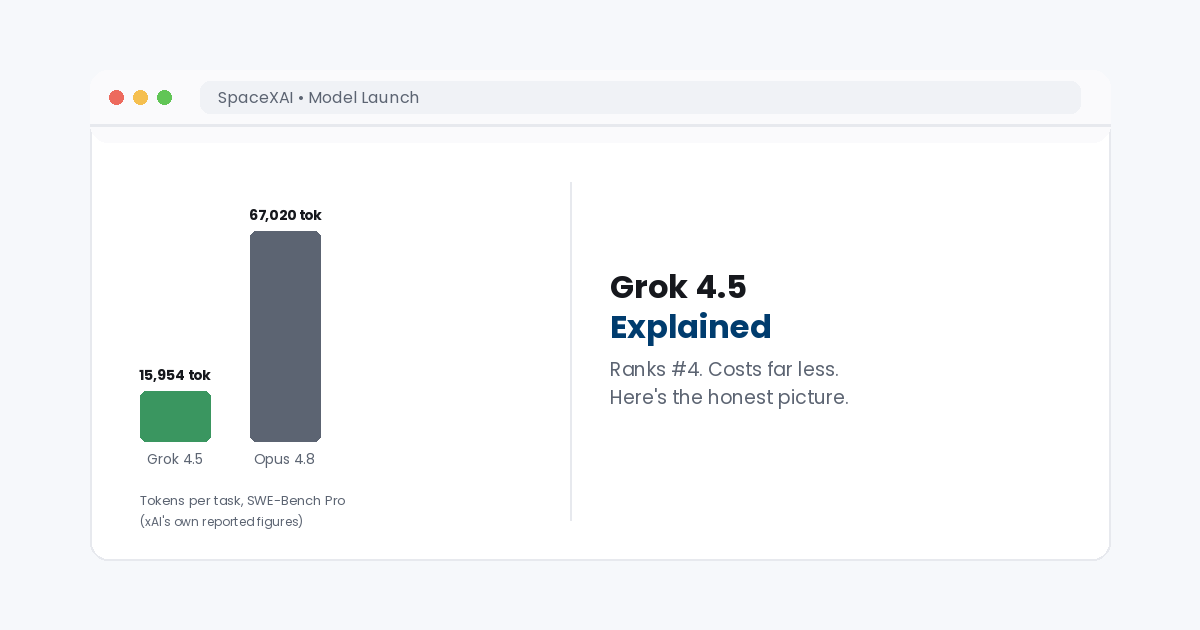
Grok 4.5 uses a fraction of the tokens Opus 4.8 needs for the same task. That efficiency is the real story.
Grok 4.5 launched on July 8, 2026, and the pitch was bold: an Opus-class model, but faster, cheaper, and far more token-efficient. Some of that holds up. Some of it is marketing doing marketing’s job. This guide separates the two, using xAI’s own published numbers alongside independent benchmarks, so you can judge grok 4.5 on what it actually does rather than what the launch post claimed.
The short answerGrok 4.5 is xAI’s newest flagship model, built on a 1.5-trillion-parameter foundation and trained on tens of thousands of Nvidia GB300 GPUs. Artificial Analysis ranks it 4th of 168 models overall, behind Claude Fable 5, GPT-5.5, and Claude Opus 4.8. It splits its own published benchmarks roughly evenly against Opus 4.8, but it is genuinely far cheaper and more token-efficient than any comparable frontier model.
1.What is Grok 4.5?
Grok 4.5 is the newest flagship model from SpaceXAI. This is the entity xAI became after merging into SpaceX in February 2026. It runs on a 1.5-trillion-parameter foundation model. Training happened on tens of thousands of Nvidia GB300 GPUs inside Colossus, xAI’s Memphis supercomputer. Notably, training also pulled in real developer session data from Cursor. In fact, SpaceX separately agreed to acquire that coding editor for $60 billion in June 2026.
2.Where it actually ranks
Artificial Analysis, an independent benchmark service, tested Grok 4.5 on a shared harness alongside every other major model. Its verdict: Grok 4.5 scores 54 on the Intelligence Index. That ranks it 4th out of 168 models tested. Overall, it sits behind Claude Fable 5, GPT-5.5, and Claude Opus 4.8. Still, it beats every open-weight model and Google’s Gemini. For context, that is a genuine 16-point jump over the previous Grok 4.3.
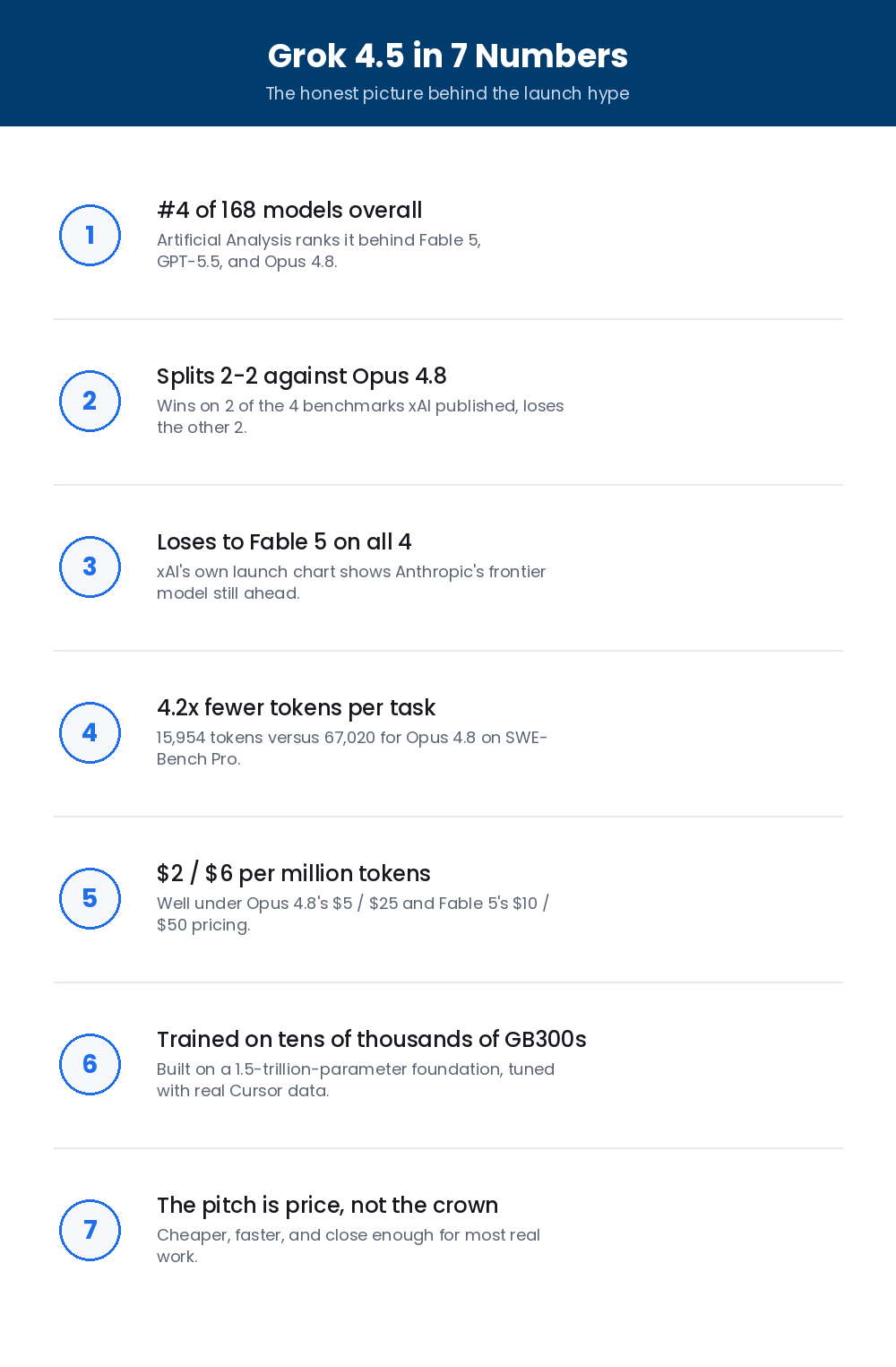 Grok 4.5, in seven numbers, without the launch-day spin.
3.The honest scorecard against Opus 4.8
xAI published four benchmark comparisons on its own launch page, and the picture is genuinely mixed. Grok 4.5 beats Opus 4.8 on DeepSWE 1.0 and Terminal-Bench 2.1. However, it loses on DeepSWE 1.1. It also loses on SWE-Bench Pro, the one benchmark an independent evaluator actually ran. Meanwhile, it loses to Claude Fable 5, Anthropic’s newer frontier model, on all four benchmarks xAI chose to show. In short, “Opus-class” is a fair label for a model splitting comparisons evenly. “Beats Opus” is a stronger claim than the same chart actually supports.
4.Token efficiency: the real headline
Here is where Grok 4.5 genuinely stands out. On SWE-Bench Pro, xAI reports it resolves the average task using about 15,954 output tokens. In comparison, Opus 4.8 needs 67,020 tokens running at maximum effort. That is a 4.2x efficiency gap. Pricing adds to the gap too: $2 per million input tokens and $6 per million output tokens, well under Opus 4.8’s $5 and $25. At real production volume, that cost advantage compounds fast.
5.What people are building with it
Launch demos leaned hard into single-prompt builds. People showed interactive 3D solar system simulations. Others generated full weather apps from scratch in minutes. Overall, these demos are genuinely fun to watch. Still, treat any vendor’s own launch-day demo the way you would treat its benchmark chart. It is impressive, self-selected, and not yet independently verified at scale.
6.Why cheap, fast, and capable compounds
Individually, none of these numbers would reshape the AI market. A model that is only cheaper is a rounding error in a fast-moving field. So is a model that is only faster, or only slightly better on two benchmarks. Together, though, they add up to something the industry has genuinely lacked: frontier-adjacent performance without frontier-tier pricing.
For a broader look at where all this AI infrastructure spending is actually going, see our guide to the AI spending surge. For the full launch details, see this TechCrunch coverage of the launch. This detailed guide from CodersEra covers the rest.
What this means for your business
You do not need the single smartest model for most real work. Instead, look at what a task actually costs at your real volume. That matters more than which model wins a benchmark chart.
If Grok 4.5’s efficiency claims hold up under your own testing, routine coding and agentic tasks may cost a fraction of what they do today. Either way, test it against your own workload before switching, the same way you should test any new model.
Frequently asked questions
Does Grok 4.5 actually beat Claude Opus 4.8?
Mixed. By xAI’s own published chart, Grok 4.5 beats Opus 4.8 on two of four highlighted benchmarks. It loses on the other two, including the one benchmark an independent evaluator ran. It does not beat Fable 5, Anthropic’s newer frontier model, on any of the four.
What is SpaceXAI?
SpaceXAI is the renamed entity formed after SpaceX absorbed xAI in a February 2026 merger. Grok 4.5 is its first major public model release. It also ties into SpaceX’s separate $60 billion deal to acquire the coding editor Cursor.
Why is Grok 4.5’s token efficiency a bigger deal than its benchmark scores?
Benchmark scores measure accuracy once. Token efficiency measures what a task costs every single time it runs. xAI reports Grok 4.5 uses about 4.2 times fewer tokens than Opus 4.8 on SWE-Bench Pro. That compounds into large savings at real production volume.
Not sure which AI model actually fits your workload?
TekShove’s Web Development team can help you test real models against your real tasks, instead of trusting a launch-day benchmark chart.
Talk to Our Team
Tell us what you need help with and our team will get back to you.