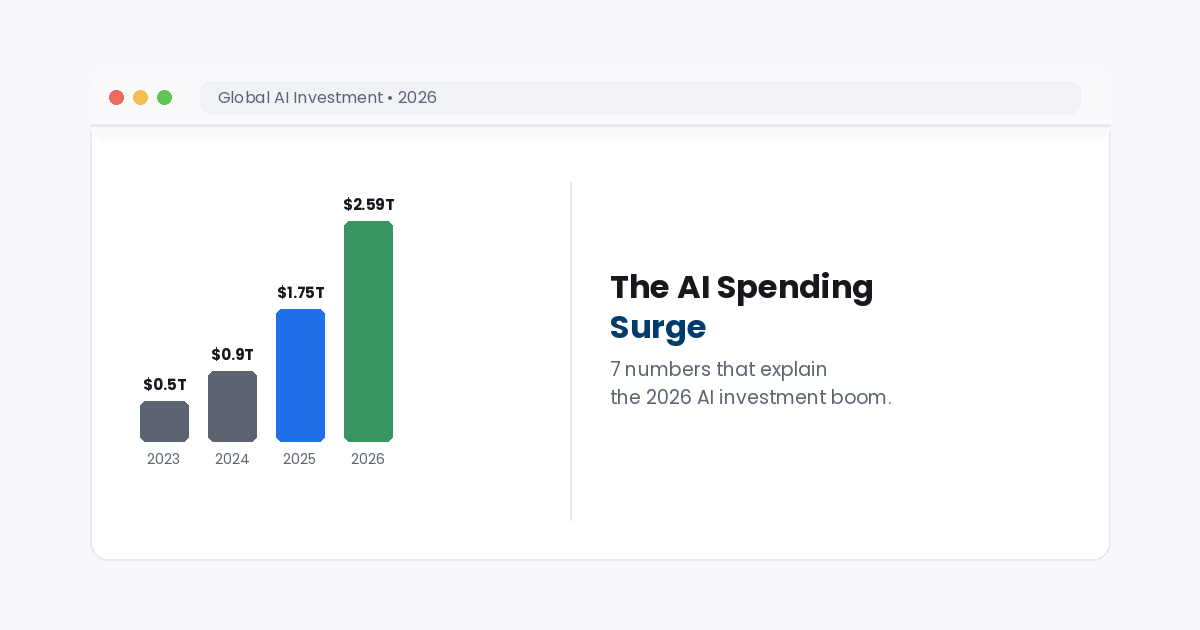
From $0.5 trillion to $2.59 trillion in three years — the ai spending surge, in one chart.
The ai spending surge is one of the biggest economic stories of 2026, and the numbers behind it are genuinely hard to picture. Worldwide AI spending is on track to pass $2.59 trillion this year, and the money is flowing from every direction at once: hyperscaler capital budgets, corporate IT spend, venture capital, and government contracts. This guide breaks the ai spending surge down into 7 numbers that actually explain what’s happening, in plain English, plus what it means if you run a much smaller business than Amazon or Microsoft.
1.$2.59 trillion: total worldwide AI spending in 2026
Gartner forecasts that worldwide AI spending will reach $2.59 trillion in 2026, a 47% jump from the year before. This figure covers the entire AI stack: hardware, cloud infrastructure, software, platforms, and services, not just chips or data centers. Consequently, it’s the broadest and most frequently quoted number in any conversation about the ai spending surge.
Gartner also notes that AI-optimized infrastructure, servers, networking, and processors, will account for over 45% of that spending, since cloud providers are racing to build enough capacity for the workloads still to come.
2.$800 billion: Goldman Sachs’ year-end AI spending forecast
Goldman Sachs projects AI-related spending will hit $800 billion by the end of 2026, up from an annualized $650 billion in the first quarter alone. Because this spending now touches servers, memory chips, power infrastructure, and software platforms, and not just semiconductor stocks, the ripple effects extend across the entire technology supply chain rather than staying contained to a handful of chip companies.
3.$1.1 trillion: hyperscaler capital spending expected in 2027
Analysts expect capital expenditures from the largest cloud providers to reach roughly $650 billion in 2026 and then surpass $1.1 trillion in 2027. In other words, 2026 isn’t the peak of the ai spending surge; it’s closer to the middle of a multi-year buildout that some analysts compare to historic infrastructure booms like the railroad expansion or the telecom buildout of the late 1990s.
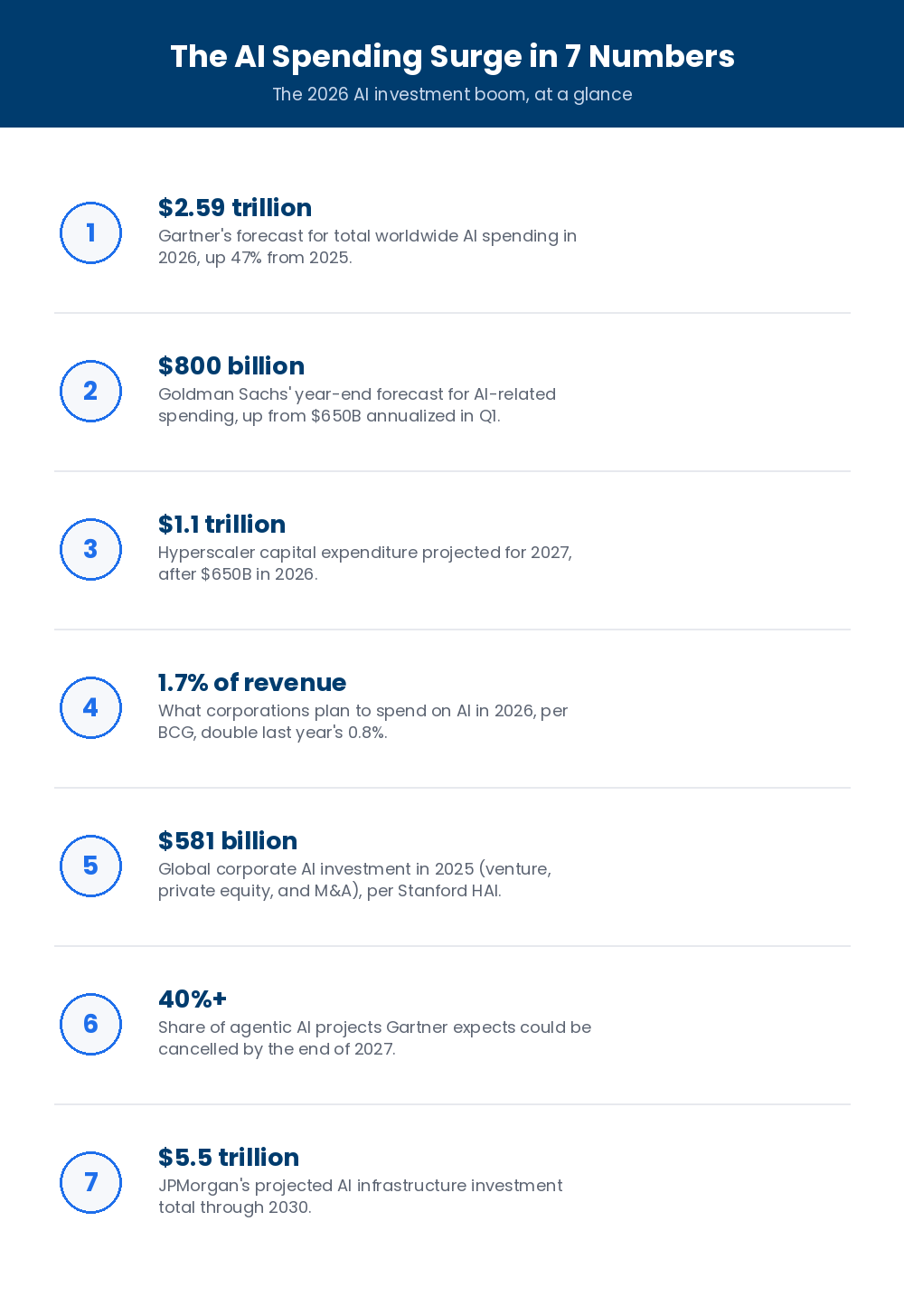
The ai spending surge, summarized in seven numbers.
4.1.7% of revenue: what companies plan to spend on AI
According to a BCG survey of nearly 2,400 executives, corporations expect to roughly double their AI spending in 2026, from about 0.8% of revenue to 1.7%. Therefore, this is one of the clearest signs that the ai spending surge isn’t only a hyperscaler story; ordinary companies across industries are shifting AI from an experiment into a funded budget line.
That said, spending varies widely by industry: while some sectors are pushing well past 2% of revenue, industrial companies and real estate firms plan to spend less than 1%, since AI simply matters less to their day-to-day operations.
5.$581 billion: global corporate AI investment in 2025
Stanford’s AI Index reports that global corporate AI investment, covering venture funding, private equity, and acquisitions, reached $581 billion in 2025, up 130% from the year before. This is a different number from Gartner’s $2.59 trillion figure: it measures money invested into AI companies, not money spent on AI tools and infrastructure, but it tells the same underlying story from a different angle.
6.40%+: the risk hiding behind the ai spending surge
Not every number behind the ai spending surge is a growth statistic. Gartner also projects that more than 40% of agentic AI projects could be cancelled by the end of 2027, and its research currently finds only about 17% of organizations have actually deployed AI agents in production. As a result, the spending boom and the results boom are running on two different timelines, and plenty of AI budget is still being spent on projects that won’t make it to a working product.
7.$5.5 trillion: where the ai spending surge is heading by 2030
JPMorgan now estimates that global AI-related capital expenditure will total $5.5 trillion through 2030, with more than 80% of that spending still ahead. In short, if these projections hold, 2026 is closer to the early chapters of this story than the ending, which is precisely why the ai spending surge is drawing comparisons to previous multi-decade infrastructure cycles rather than a short-term trend. You can read the full breakdown of Big Tech’s capital spending plans at Fortune’s coverage of the AI spending boom, and Gartner’s own 2026 AI spending forecast for the underlying methodology.
What the ai spending surge means for a small or mid-sized business
None of these trillion-dollar numbers mean your business needs a bigger AI budget than it can justify. However, they do mean AI tool spending is now a normal, expected line item rather than an experiment, and competitors in your space are increasingly budgeting for it deliberately rather than dabbling. A sensible approach is to treat AI the way BCG’s surveyed executives increasingly do: pick a small, specific percentage of revenue or budget, spend it on tools that solve a real problem, and measure whether it actually saves time or money before expanding further.
Frequently asked questions
Is the ai spending surge the same as the AI investment boom?
They overlap but aren’t identical. Spending refers to money companies pay for AI tools, infrastructure, and services. Investment refers to money flowing into AI companies through venture capital, private equity, and acquisitions. Both are surging in 2026, but they measure different parts of the same story.
Why do different reports give such different numbers for AI spending?
Because they’re measuring different things. Gartner’s $2.59 trillion covers the full AI stack that organizations spend money on. IDC’s AI infrastructure tracker covers only hardware. Stanford’s $581 billion figure covers investment dollars flowing into AI companies. All three numbers are accurate; they simply aren’t interchangeable.
Should a small business worry about the AI spending surge?
Not in the sense of needing to match it. Still, it’s worth treating AI tool spending as a deliberate, small, and measured part of your budget rather than something to ignore entirely, since the businesses around you are increasingly doing the same.
Not sure where AI actually fits in your budget?
If you want a clear-eyed, jargon-free look at which AI tools are actually worth paying for in your business, TekShove’s Web Development team can help you separate the useful from the hype.
Talk to Our Team
Tell us what you need help with and our team will get back to you.