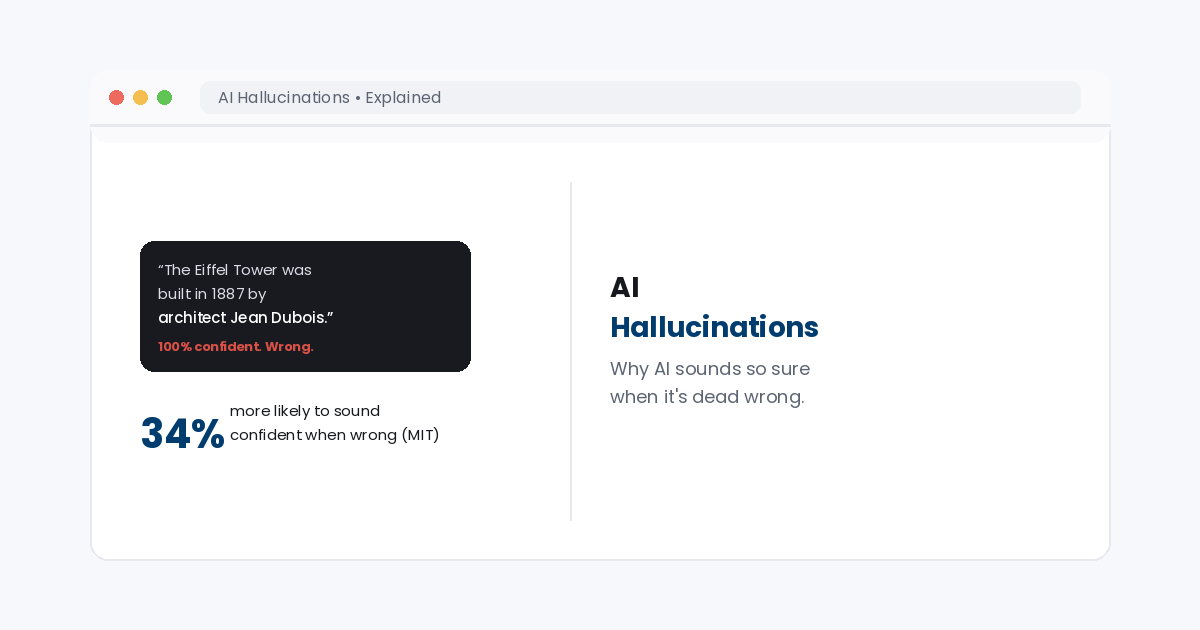
 A wrong answer, stated with total confidence. AI hallucinations, in one image.
Ask an AI tool a question it doesn’t actually know, and it rarely says so. Instead, it often makes one up, and says it with total confidence. AI hallucinations are one of the strangest, most misunderstood problems in modern tech. This guide explains why they happen, how common they really are, and what actually cuts them down, based on real research rather than guesswork.
The short answer
AI hallucinations happen because language models guess the next likely word rather than pull up checked facts. They don’t actually know what’s true. OpenAI’s own 2026 research found that standard training rewards a confident guess over honest doubt. That’s why wrong answers often sound just as sure as right ones. Hallucination rates swing wildly by task, from near 1% on simple summaries to over 80% on specific legal questions. Grounding answers in real documents, known as RAG, remains the best fix, cutting rates by up to 71%.
1.What an AI hallucination actually is
IBM explains it plainly. An AI hallucination is output that sounds real but is wrong, off-topic, or fully made up. That can mean a fake source, an invented number, or wrong facts about a real person or event. Notably, it reads just like true information. Nothing about the tone gives away that it’s false. That’s exactly what makes it so easy to miss.
2.Why it happens: the real technical reason
Language models don’t pull up stored facts the way a search engine does. Instead, they guess the most likely next word, based on patterns learned from huge amounts of text. That’s what makes them sound so smooth and natural. It’s also what makes ai hallucinations so likely to occur. OpenAI shared research in 2026 that explains the deeper cause. Standard training and grading methods reward a confident guess more than an honest admission of doubt. In other words, a model that guesses right scores better than one that admits it isn’t sure.
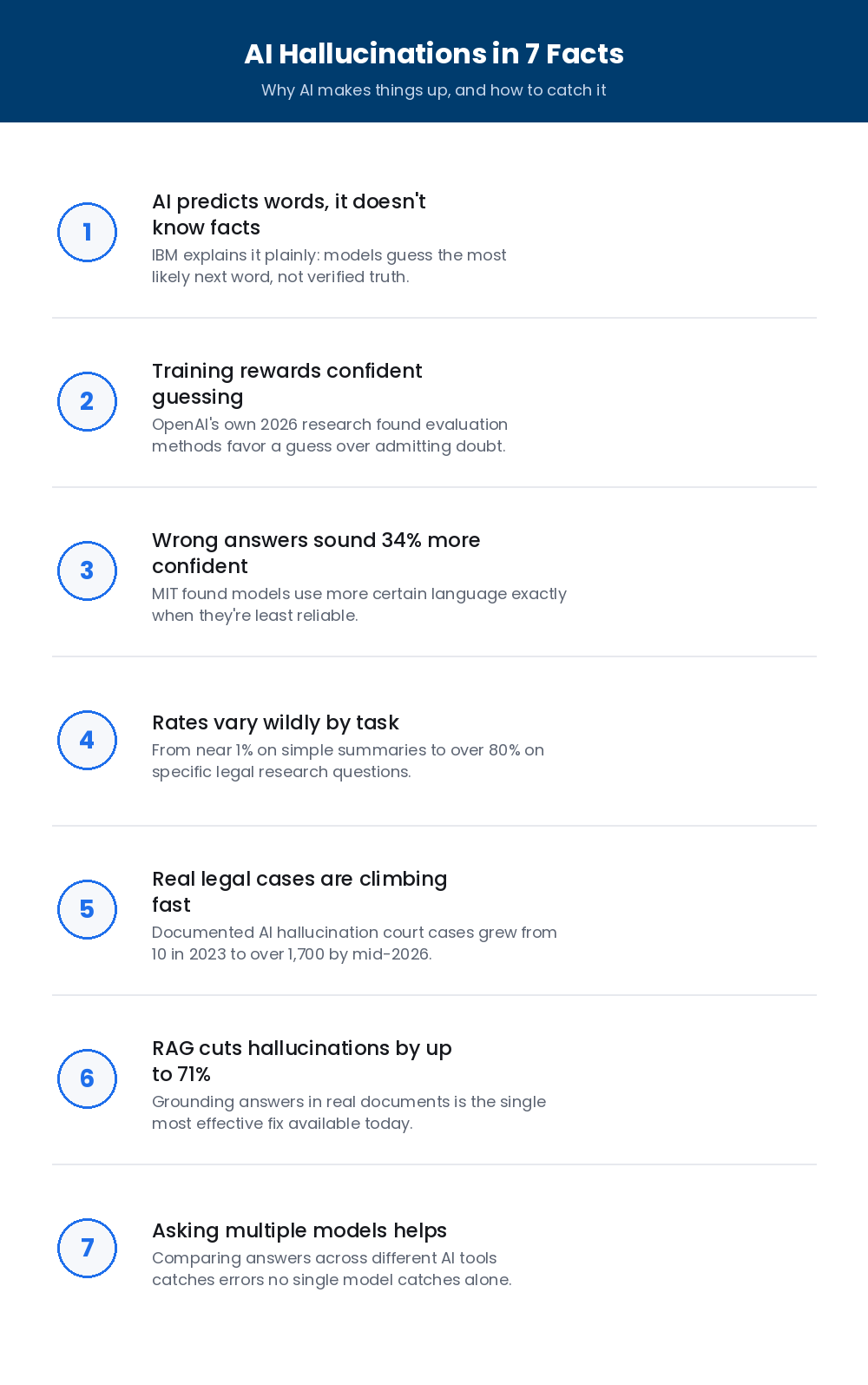 AI hallucinations, the real research behind them in seven facts.
3.The unsettling part: confident wrong answers
Here’s the part that catches most people off guard. Researchers at MIT found that AI models are about 34% more likely to sound sure and firm exactly when they get facts wrong. In short, the wrongest answers often sound the most trustworthy. This is the opposite of how human doubt usually works. A person unsure of a fact tends to hedge. In contrast, a hallucinating model often does the reverse. That makes tone a poor sign of real accuracy.
Using AI for real business content or research?
We’ll walk through your actual workflow and show you where hallucination risk is highest, and how to catch it before it reaches a client.
4.How common is it, really?
Honestly, it depends a lot on the task. Recent benchmark data shows hallucination rates as low as roughly 1% on simple, well-grounded summaries. On specific legal research questions, Stanford researchers found rates between 58% and 88%, depending on the model and the question type. Even special legal AI tools sold as accurate still get things wrong on 17% to 34% of queries. The gap is not random. Tasks that need open-ended fact recall carry far more risk than tasks working from a fixed set of source documents.
5.Real-world consequences of ai hallucinations
This isn’t just a school topic anymore. Documented legal cases tied to AI hallucinations grew from just 10 in 2023 to more than 1,700 worldwide by mid-2026. Courts have handed out real fines, including a single penalty of 109,700 dollars against one lawyer in early 2026. Beyond the legal world, one 2026 study found AI-made summaries swayed real purchase choices while getting facts wrong 60% of the time. Clearly, the money and reputation at stake are no longer hypothetical.
6.What actually reduces hallucinations
The most effective fix today is retrieval-augmented generation, known as RAG. Instead of relying purely on prediction, RAG grounds a model’s answers in specific, real documents. Done well, this can cut hallucination rates by up to 71%. Checking answers across several different AI models helps too, since different models tend to fail on different questions. Notably, prompting matters as well. Giving a model clear permission to say it doesn’t know, instead of forcing a guess, is a simple, proven trick. Our prompt engineering guide covers this exact approach in more depth.
What ai hallucinations mean for how you use AI
Treat any confident AI answer as a starting point, not a final word, especially for facts, numbers, or anything with real stakes. Ask the model where its info comes from. Check anything specific before you repeat it.
Our guides to AI coding tools and AI-powered web development cover more on how we build AI into real client work responsibly. This official explainer on AI hallucinations from IBM and this 2026 hallucination rate research roundup cover further reading.
Frequently asked questions
What exactly is an AI hallucination?
An AI hallucination is when a model makes output that sounds real but is wrong, off-topic, or fully made up. This includes a fake source, an invented number, or wrong facts about a real person or event.
Why do AI models sound so confident even when they’re wrong?
Research from MIT found that AI models are about 34% more likely to sound sure and firm exactly when they get facts wrong. This happens because standard training rewards a confident-sounding guess more than an honest admission of doubt.
What is the single most effective way to reduce AI hallucinations?
Retrieval-augmented generation, known as RAG, is the most effective fix right now. Grounding a model’s answers in real, specific documents instead of open guessing can cut hallucination rates by up to 71%.
Want AI content and tools you can actually trust?
TekShove builds real fact-checking and human review into every AI-assisted project, so confidence never gets mistaken for accuracy.
Talk to Our Team
Tell us what you need help with and our team will get back to you.