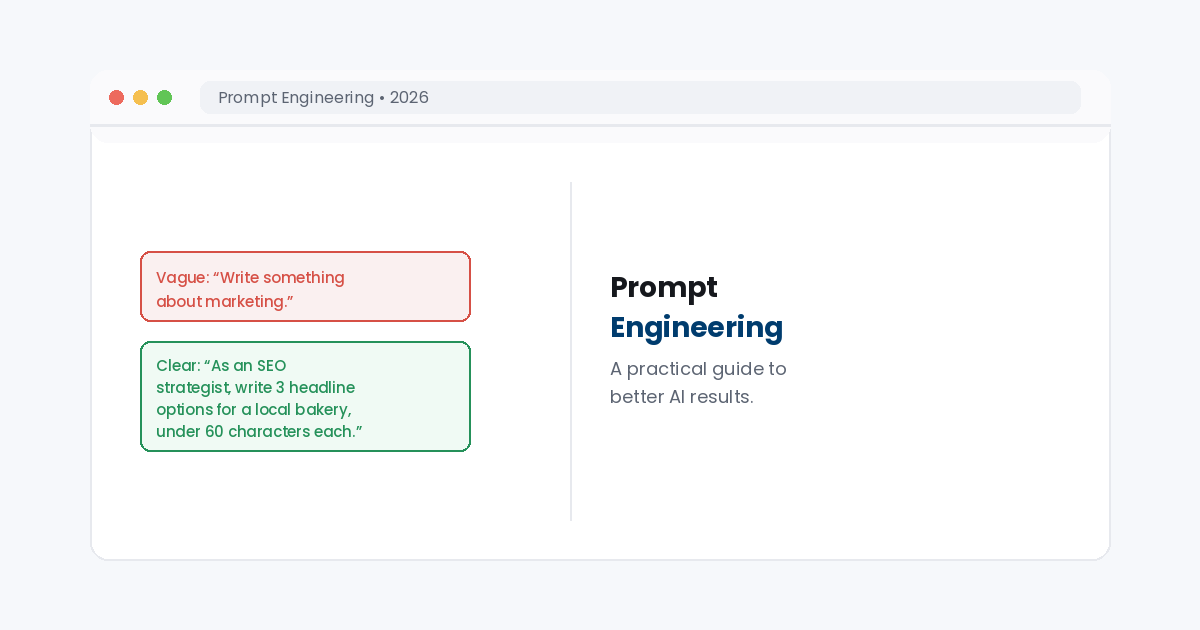
One vague prompt. One clear prompt. Prompt engineering is the difference between them.
Most people who feel let down by AI aren’t using a weak model. Instead, they’re using a weak prompt. Prompt engineering is the skill of turning a vague request into clear instructions an AI model can actually act on. This guide covers the habits that genuinely improve results. It’s straight from Anthropic’s own best practices and current 2026 research, not outdated tricks from a few years ago.
The short answer
Prompt engineering means writing clear, specific instructions so an AI model understands exactly what you need. Start with one example instead of five. Give the model explicit permission to say it doesn’t know something, since this reduces hallucinations. Keep any assigned role short and relevant. Instead of hoping the model infers your instructions, state them directly. These habits alone fix most disappointing AI results.
1.What prompt engineering actually is
At its core, prompt engineering is just changing the request you send an AI model. Often, that means adding the right context before your real question. Knowing which details matter is the real skill here. The market reflects how seriously this is now taken. Prompt engineering is set to grow from roughly 222 million dollars in 2023 to over 2 billion dollars by 2030. Grand View Research tracked this shift closely. That growth traces back to one simple fact. Better prompts produce better, more reliable output.
2.Start with one example, not five
Anthropic’s own team suggests starting with a single example. This is known as one-shot prompting. Add more examples, called few-shot prompting, only if the output still misses the mark. This matters because extra examples add real cost. Each one uses more tokens. In fact, they can also accidentally push the model toward one narrow pattern instead of real understanding. Notably, testing one clear example first, then adding more only when needed, keeps prompts simple and easy to fix.
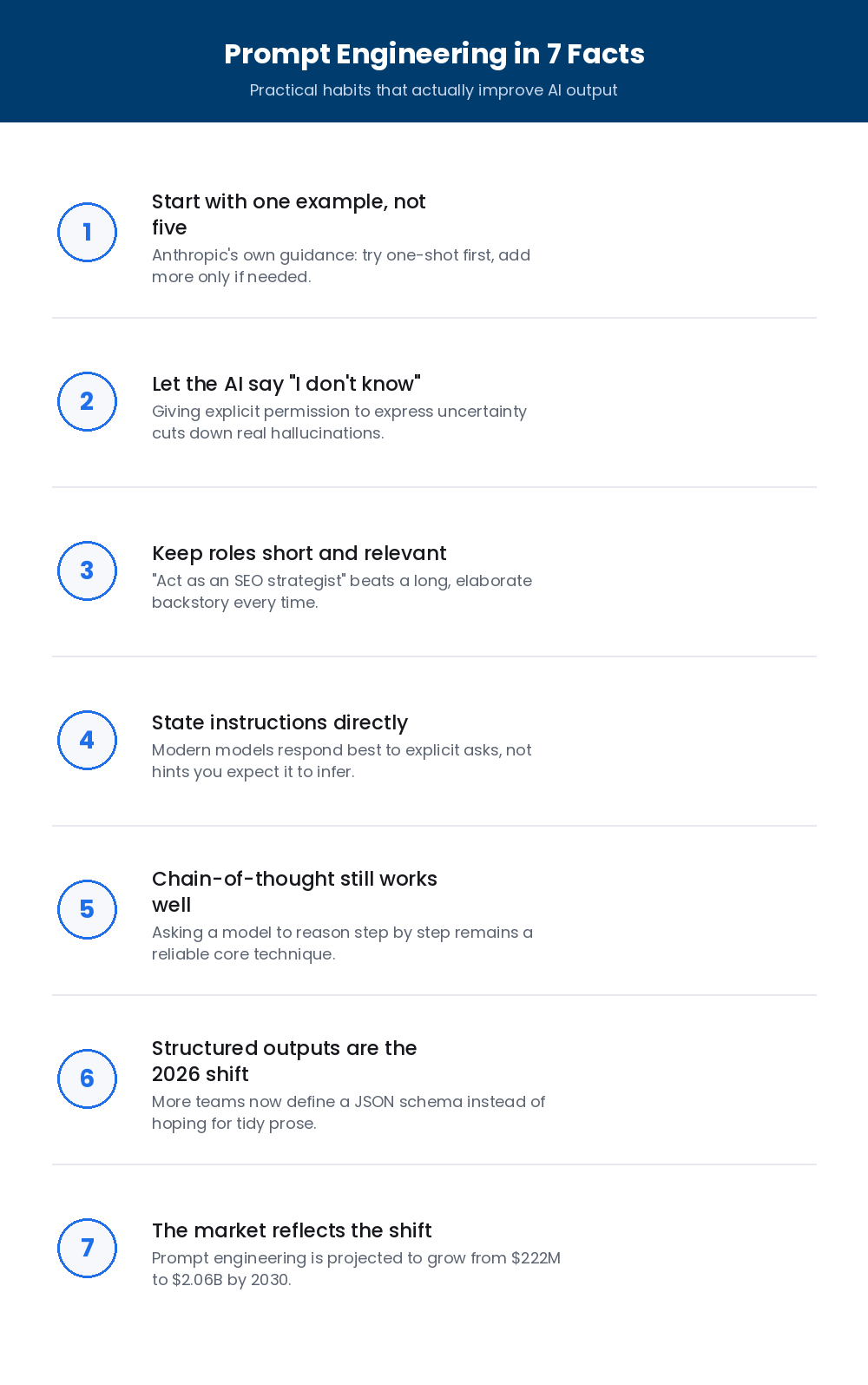
Prompt engineering, seven habits that actually move the needle.
3.Let the AI say it doesn’t know
This one habit does more to fix hallucinations than most people expect. Giving a model clear permission to admit uncertainty, instead of forcing a confident-sounding guess, really helps improve trust in the output.
That one addition changes the model’s behavior. Overall, instead of filling gaps with a plausible-sounding guess, it tells you where its own confidence actually runs out. This single change measurably improves reliability. Notably, it also reduces hallucinated answers in a real, testable way.
Want your team actually using AI well, not just using it?
We’ll walk through your real workflows and show you where better prompting saves genuine time.
4.Role-based prompting, done right
Giving a model a role, like “act as an SEO strategist,” genuinely helps focus its output. The trick is restraint. Best practice means picking a role that’s realistic and fits the task, stating it briefly at the start, and pairing it with clear instructions. A long backstory rarely helps. Overall, it often adds noise instead, pulling the model’s focus away from the real task at hand.
5.Chain-of-thought and when to go further
Asking a model to reason step by step, known as chain-of-thought prompting, remains one of the most reliable core techniques around. For real complex or high-stakes tasks, more advanced methods exist too. Self-consistency prompting builds several reasoning paths, then picks the most consistent answer among them. Meta-prompting focuses on logical structure over specific examples. That helps when few-shot examples risk adding bias. Still, most everyday tasks never need these advanced layers. Save them for work where getting it wrong actually costs something real.
6.The 2026 shift toward structured outputs
A real shift is underway this year. Instead of hoping for tidy prose, more teams now set an exact output format, like a JSON schema. They have the model fill it in directly. This matters most for production systems where AI output feeds right into another tool or database. A clear schema is far easier to check by machine than a well-written paragraph. For everyday writing and research tasks, plain instructions still work just fine. The structured approach earns its extra work mainly at real production scale.
How TekShove applies this in real work
These aren’t abstract tips for us. Instead, we use structured, tested prompts across content writing, code generation, and SEO research daily. A vague prompt costs real time in revisions. Instead, a clear one saves that time entirely. That difference shows up directly in how fast and how well a project moves.
Our guides to AI-powered web development, AI coding tools, and generative AI versus AI agents versus agentic AI cover more on how AI fits into our broader process. This official prompt engineering guide from Anthropic and this technique breakdown from K2View cover the original guidance behind this piece.
Frequently asked questions
What is prompt engineering in simple terms?
Prompt engineering means writing clear, well-built instructions for an AI model, so it makes accurate, useful output. It’s the bridge between what you actually want and what the AI understands you’re asking for.
How many examples should I include in a prompt?
Start with one example, known as one-shot prompting, according to Anthropic’s own guidance. Only add more examples, moving to few-shot prompting, if the output still doesn’t match what you need.
Can prompt engineering actually reduce AI hallucinations?
Yes, to a meaningful degree. Telling the model it’s allowed to say it doesn’t know, rather than forcing a confident-sounding guess, measurably reduces hallucinated answers. It also increases how trustworthy the output actually is.
Want AI that actually works the way your business needs?
TekShove builds real prompting and AI workflows into everyday client work, not just theory. Let’s talk about your project.
Talk to Our Team
Tell us what you need help with and our team will get back to you.