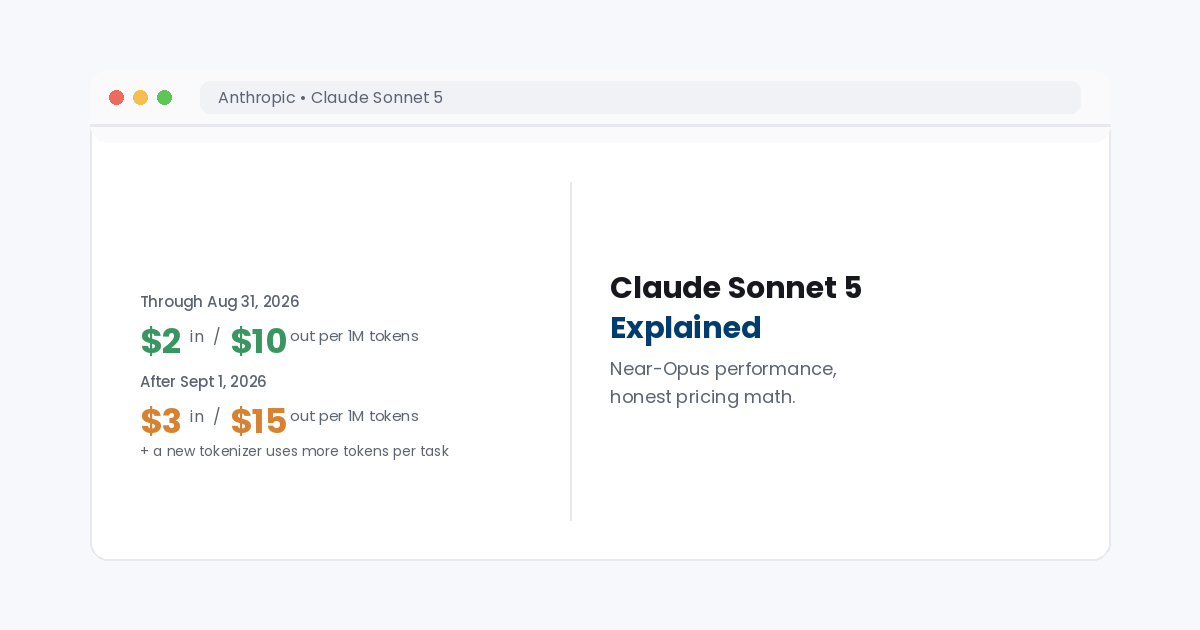
Two price tags, one deadline. Claude Sonnet 5’s real cost story starts after August 31.
Claude Sonnet 5 launched on June 30, 2026, as Anthropic’s most agentic Sonnet model yet. It runs plans, drives tools, and handles multi-step work that used to require the pricier Opus line. The pitch is simple: near-Opus performance at a fraction of the cost. The real story is a little more layered. This guide covers what Claude Sonnet 5 actually does, what it costs once you read past the headline price, and where it still falls short of the flagship model it is chasing.
The short answerClaude Sonnet 5 is Anthropic’s new mid-tier model, priced at $2 per million input tokens and $10 per million output tokens through August 31, 2026, then $3 and $15 after that. It performs close to Opus 4.8 on several tasks but still trails on pure agentic coding. A new tokenizer can also turn the same English text into up to 42% more billable tokens, so the real cost is worth checking against your own workload before you assume it is cheaper.
1.What is Claude Sonnet 5?
Claude Sonnet 5 sits between Haiku and Opus in Anthropic’s lineup. It replaces Sonnet 4.6 as the default model for Free and Pro users on claude.ai. Max, Team, and Enterprise users can select it manually. Developers can call it through Claude Code, the Claude API, AWS Bedrock, Google Vertex, and Microsoft Foundry. It ships with a 1 million token context window and 128,000 maximum output tokens. Anthropic says it can plan, use tools like browsers and terminals, and run autonomously at a level that recently required a larger, pricier model.
2.The pricing: intro versus standard
Claude Sonnet 5 launched at an introductory price of $2 per million input tokens and $10 per million output tokens. That rate holds through August 31, 2026. After that, standard pricing kicks in at $3 per million input and $15 per million output. Notably, that standard rate is identical to what Sonnet 4.6 cost before it. On paper, the rate card looks unchanged. In practice, the jump from intro to standard is a clean 50% increase on every token.
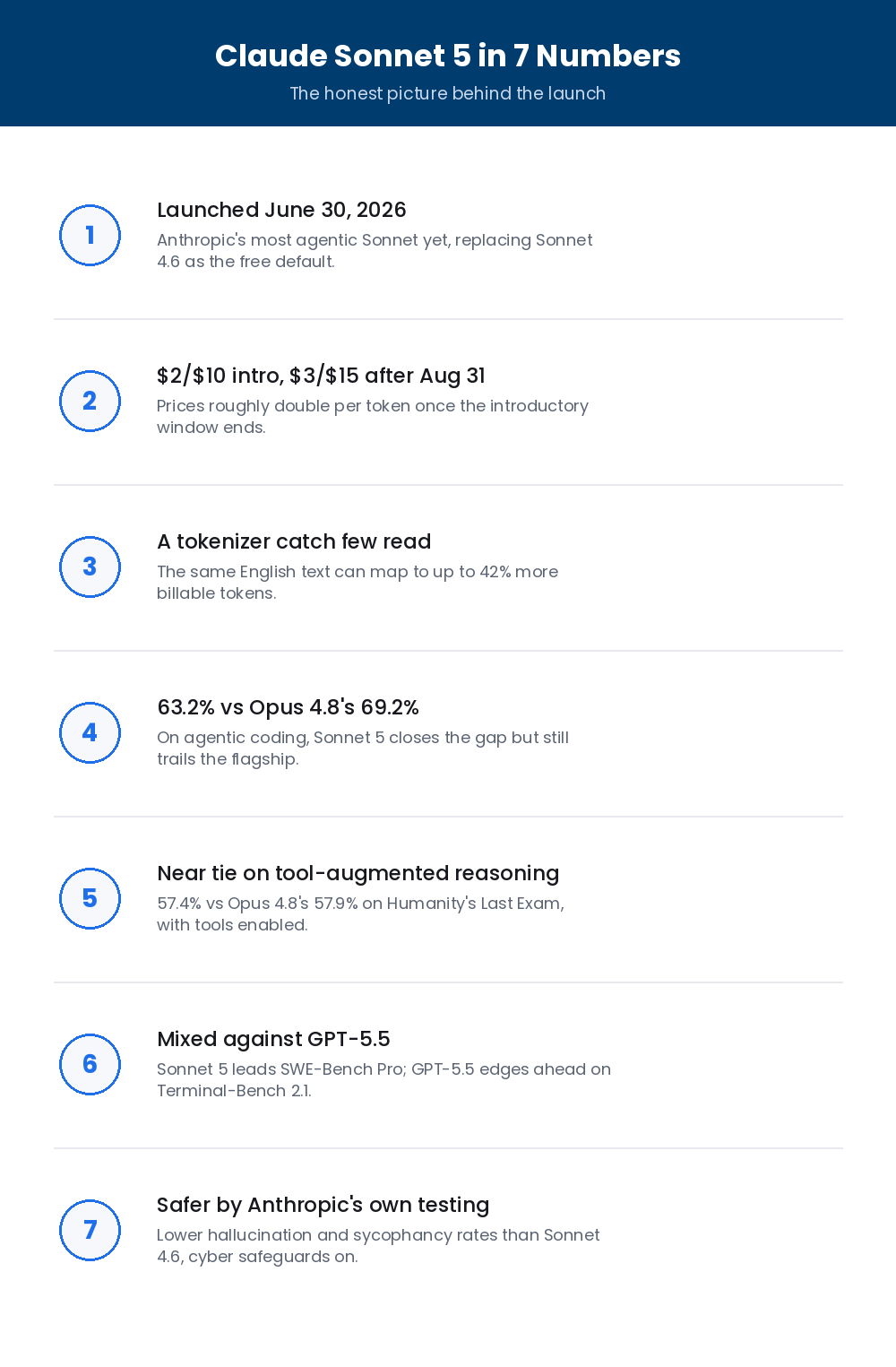 Claude Sonnet 5, in seven numbers, past the launch-day framing.
3.The tokenizer catch nobody reads
Claude Sonnet 5 uses a new tokenizer, and this detail matters more than it sounds. The same input can map to roughly 1.0 to 1.35 times more tokens than before, depending on the content type. For English text specifically, independent testing found the increase can reach as high as 42%.
Anthropic set introductory pricing to make the switch roughly cost-neutral against Sonnet 4.6. However, that framing only holds during the discount window. Standard pricing returns on September 1. At that point, the higher rate and the hungrier tokenizer combine. Many English-language workloads will then cost more than they did on Sonnet 4.6.
4.How it compares to Opus 4.8
Anthropic’s own framing is careful here: Sonnet 5’s performance is close to Opus 4.8, not equal to it. On one agentic coding benchmark, Sonnet 5 scores 63.2%. Opus 4.8 scores 69.2%, and Sonnet 4.6 scored 58.1%. That is real, meaningful progress, but a six-point gap still separates it from the flagship.
On a knowledge work benchmark measuring tool-augmented reasoning, the two models sit much closer together. Sonnet 5 scores 57.4%, versus 57.9% for Opus 4.8. For tasks where a single wrong step is costly, Opus 4.8 remains the safer pick.
5.How it compares to GPT-5.5
Anthropic published no official comparison against GPT-5.6, since that model had not launched when Sonnet 5 shipped. Against GPT-5.5, the picture is mixed rather than one-sided. Sonnet 5 leads on SWE-bench Pro, scoring 63.2% against GPT-5.5’s 58.6%. However, GPT-5.5 edges ahead on Terminal-Bench 2.1, at 83.4% versus Sonnet 5’s 80.4%. Treat any Sonnet-5-versus-GPT-5.6 comparison you see elsewhere as unofficial, since Anthropic has not published one.
6.The safety improvements
Anthropic’s pre-deployment testing found Sonnet 5 has lower rates of hallucination and sycophancy than Sonnet 4.6. Resistance to prompt injection is stronger too. Real-time cyber safeguards ship enabled by default, the same protections used in Opus 4.7 and Opus 4.8. A company betting heavily on autonomous, multi-step agent work should value that safety margin as much as the raw capability gain. The full announcement is available on Anthropic’s official Claude Sonnet 5 post, alongside this TechCrunch coverage of the launch.
What this means for your business
If you already run agentic workloads on Sonnet 4.6, testing Sonnet 5 before August 31 makes sense. The introductory price is real, and the capability gain is meaningful. Still, do not budget by the sticker price alone. Run a sample of your actual prompts through both tokenizers, and track your first week’s real bill. For a broader view of where this kind of AI investment is heading industry-wide, see our guide to the AI spending surge.
Frequently asked questions
Is Claude Sonnet 5 actually cheaper than Sonnet 4.6?
During the introductory window through August 31, 2026, yes. After that, the standard price matches Sonnet 4.6’s old rate. However, a new tokenizer can turn the same English text into up to 42% more billable tokens. The real cost for many workloads ends up higher than the sticker price suggests.
Is Claude Sonnet 5 as good as Claude Opus 4.8?
Close, but not equal. Sonnet 5 nearly matches Opus 4.8 on tool-augmented reasoning. It still trails by several points on pure agentic coding benchmarks like SWE-bench Pro. Anthropic’s own framing is that Sonnet 5’s performance is close to Opus 4.8, not better.
Should my business switch from Sonnet 4.6 to Sonnet 5 right now?
For most agentic coding and tool-use workloads, yes, especially before the August 31, 2026 price step-up. However, run your own workload through both models first. The new tokenizer can change your real cost per task regardless of the headline price.
Not sure which Claude model fits your workflow?
TekShove’s Web Development team can help you test Claude Sonnet 5 against your real workload before you commit to a migration.
Talk to Our Team
Tell us what you need help with and our team will get back to you.