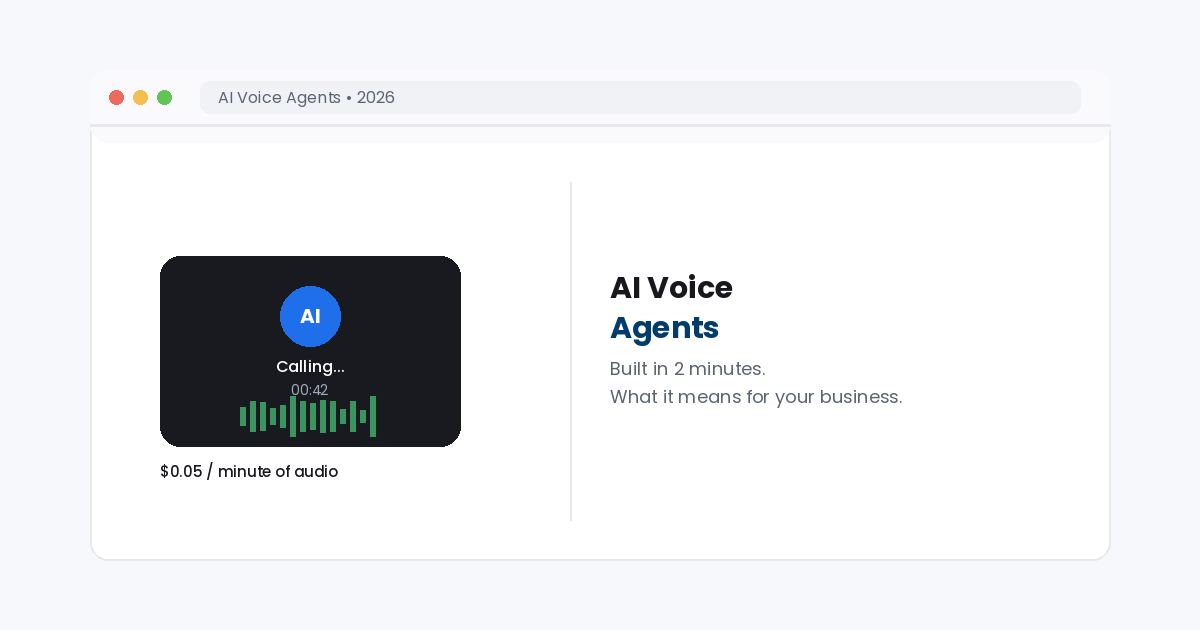
Two minutes to build. Five cents a minute to run. AI voice agents just crossed a real cost threshold.
AI voice agents used to require a developer, three separate vendor accounts, and weeks of setup. On July 1, 2026, xAI launched a no-code Voice Agent Builder that collapses all of that into a browser console and a two-minute setup. This guide explains what AI voice agents actually do, what they cost in practice, and what still needs testing before you trust one with a real customer call.
The short answerAI voice agents are phone-answering systems built on speech-to-speech AI models instead of a stitched-together stack of separate tools. xAI’s new Voice Agent Builder lets anyone configure one in under two minutes, priced at $0.05 per minute of audio plus $0.01 per minute for telephony. They handle narrow, well-defined calls well today. Complex phone trees and edge cases still need real testing before a full rollout.
1.What is an AI voice agent?
An AI voice agent answers or makes phone calls using an AI model instead of a human. Older systems stitched together three separate pieces: speech-to-text, a language model, and text-to-speech. Each hop added cost, delay, and a chance of something breaking. Instead, newer voice agents, including xAI’s Grok Voice, use a single speech-to-speech model. As a result, fewer moving parts generally means lower latency and fewer failure points on a live call.
2.Inside xAI’s no-code Voice Agent Builder
xAI launched Voice Agent Builder in beta on July 1, 2026. It runs entirely in a browser, with no code required. First, you describe how a call should go, then connect a knowledge base or external tools. Next, pick from more than 80 voices across 25-plus languages. Finally, deploy through a phone number or a direct SIP connection. Every account ships with one free provisioned number. Teams can also clone a brand voice from about two minutes of sample audio.
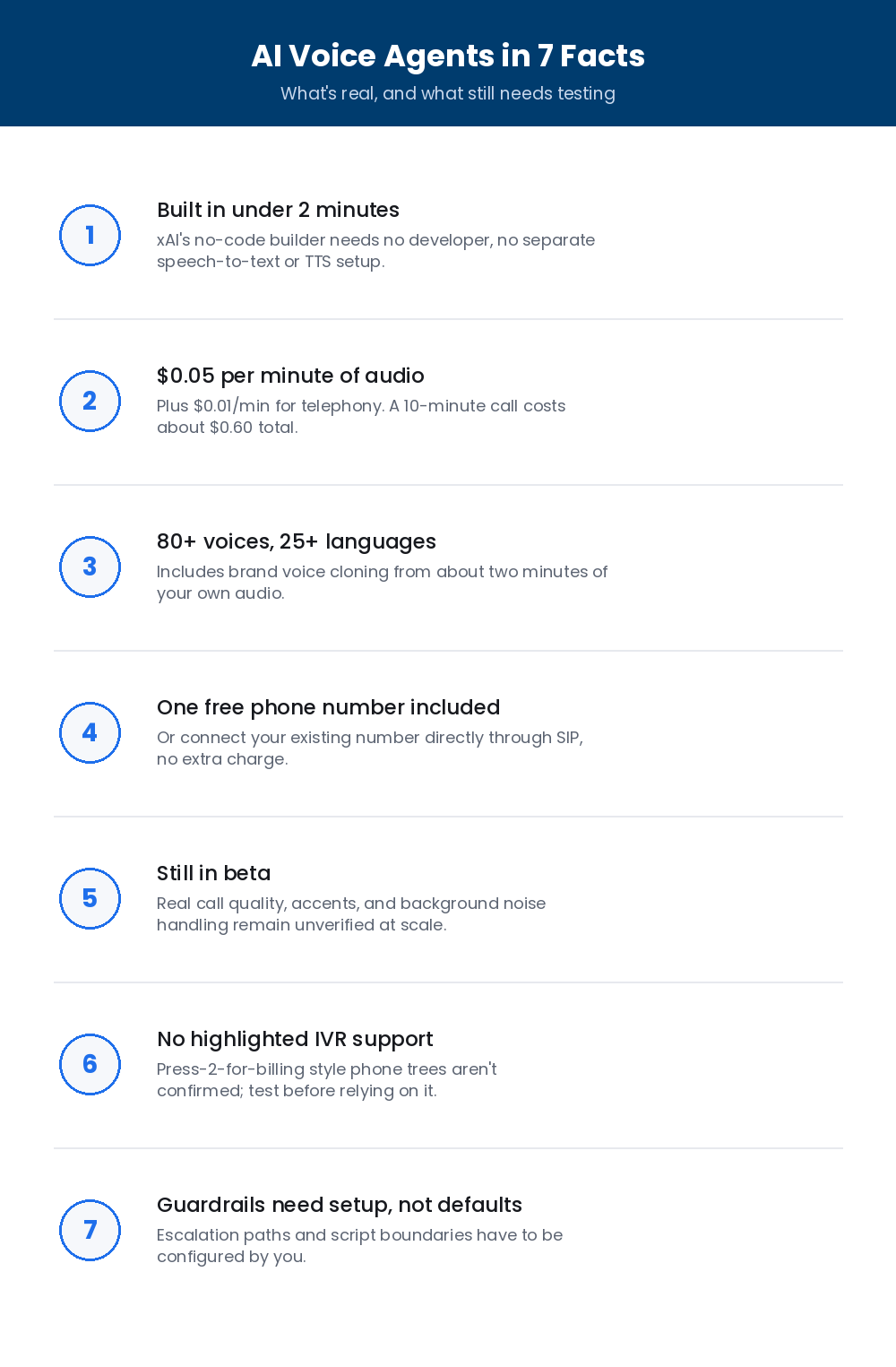 AI voice agents in 2026, what’s confirmed and what still needs testing.
3.What AI voice agents actually cost
xAI prices Voice Agent Builder at $0.05 per minute of agent audio. Telephony on a provisioned number adds $0.01 per minute. In practice, a 10-minute customer support call costs roughly $0.60 total. That undercuts established voice AI vendors like ElevenLabs and Vapi, according to industry reporting. For a small business testing whether a voice agent even helps, the entry cost is now genuinely low. Overall, you can try it without a long procurement cycle.
Free consultation
Curious what an AI voice agent would sound like for your business?
We’ll map one real call flow from your business. Appointment booking, order status, or FAQ handling all work well as a starting point. See what it could look like before you spend a cent on a platform.
4.What they’re good for right now
Narrow, predictable tasks are where AI voice agents perform best today. Booking an appointment, checking an order status, answering a short list of common questions, or taking a basic message all fit well. These are scripted enough that a well-configured agent handles them reliably. Notably, xAI positions its own tool for customer support, sales, and similar business-critical functions. That framing matches where the wider industry sees the clearest early wins.
5.The real risks to check before you launch
A few gaps matter more than the marketing copy suggests. The platform is still in beta. Real call quality under background noise, strong accents, and low-quality phone audio remains unverified at scale. Notably, complex phone-tree navigation, the classic press two for billing setup, is not highlighted in the launch materials. Guardrails, script boundaries, and a clear path to hand a call to a human are not default settings either. Instead, you have to configure them yourself. Skipping that step is how a voice agent ends up confidently telling a customer something wrong.
6.Not just xAI: the wider market
xAI is not alone here. ElevenLabs and Vapi already run established voice agent platforms. Google and OpenAI both ship real-time voice APIs of their own too. What changed on July 1 is one specific combination: no-code setup and aggressive per-minute pricing landing in one product at once. Whether that combination holds up depends on real-world reliability, not the launch announcement. This coverage from Slator and this practical breakdown from explainx.ai cover more detail.
What this means for your business
You do not need to be a large call center to benefit from this shift. Pick one narrow, repetitive phone task. Appointment booking is a common starting point. Test a voice agent against it before expanding further. The entry cost is low enough that a small, honest test tells you more than any demo video will. Our guide to AI agents in customer support and sales covers the broader shift in support and sales.
Frequently asked questions
How much do AI voice agents actually cost to run?
xAI’s Voice Agent Builder charges $0.05 per minute of agent audio plus $0.01 per minute for telephony. A 10-minute customer call costs roughly $0.60 total. Pricing varies by provider, but per-minute billing like this is now the industry norm.
Can a small business really build an AI voice agent without a developer?
Yes, for initial setup. No-code builders like xAI’s let you configure a voice agent in under two minutes through a browser console. Getting it production-ready, with proper guardrails, escalation paths, and real testing, still takes deliberate work.
Are AI voice agents reliable enough for real customer calls yet?
Generally yes, for narrow, well-defined tasks like appointment booking or basic support questions. Complex phone trees, upset callers, and edge cases are a different story. Most platforms remain unverified at scale there, so test with real call volume before a full rollout.
Want to see if a voice agent actually fits your business?
TekShove can help you map one real call flow, test it honestly, and decide if an AI voice agent is worth rolling out further.
Talk to Our Team
Tell us what you need help with and our team will get back to you.