Ai agents now resolve routine tickets in seconds. The real story is what happens after that.
Ai agents moved from experiment to default in 2026. Two-thirds of customer service teams now run them, and sales teams are close behind. This guide covers what ai agents actually do in support and sales, the real numbers behind the hype, and where the technology still falls short. Every figure below comes from a named, dated source.
The short answerAi agents now handle a large share of routine customer support and sales tasks, and adoption nearly doubled in a single year. However, independent data shows real deflection rates well below vendor marketing claims, and a measurable satisfaction gap still exists for complex cases. The businesses seeing the best results combine ai agents with human escalation rather than full automation.
1.Adoption crossed the tipping point
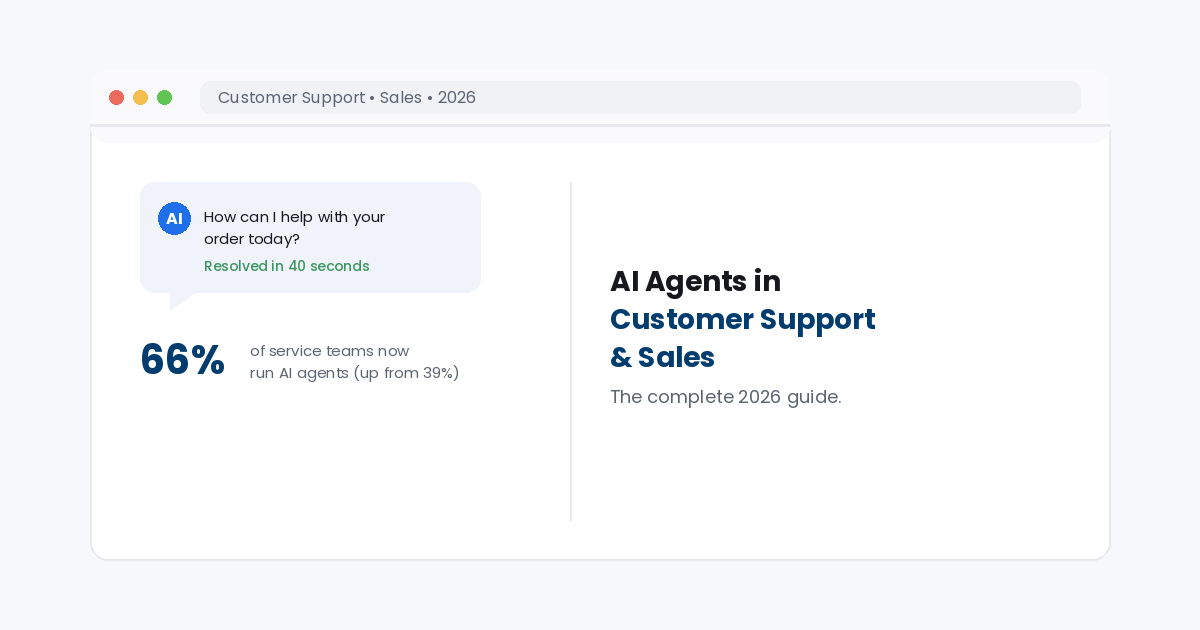
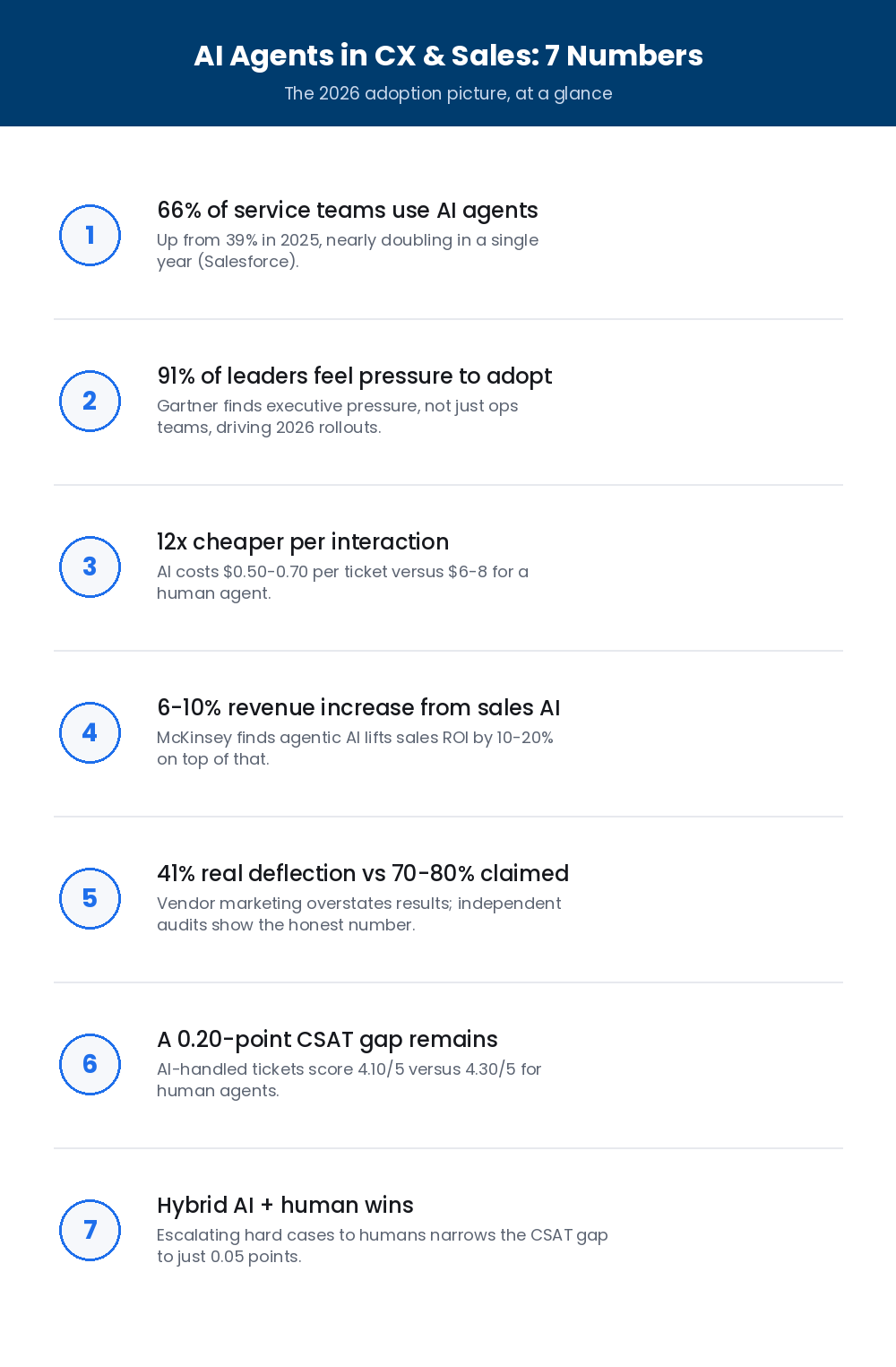
Salesforce reports that 66% of customer service organizations now use ai agents, up from 39% in 2025. That is nearly a 1.7x jump in a single year. For context, this is no longer early-adopter territory. Instead, ai agents have become the default expectation for a service team, not an experiment a few companies are trying. Meanwhile, sales teams are following the same curve, just a step or two behind.
2.Executive pressure is driving rollout speed
According to Gartner, 91% of customer service leaders say they are under pressure from executives to implement ai in 2026. Notably, this pressure is not coming from IT or operations alone. Instead, it is coming from the top, which explains why adoption jumped so quickly. As a result, teams that were cautiously piloting ai agents in 2025 are now expected to have something live.
 Ai agents in customer support and sales, in seven numbers.
3.The real cost math behind ai agents
The financial case is straightforward. Ai agents typically cost $0.50 to $0.70 per interaction, compared to $6 to $8 for a human agent handling the same ticket. In other words, that is roughly a 12x cost advantage per interaction. Across enough volume, this adds up fast: Gartner estimates it saves $80 billion in contact-center labor costs industry-wide in 2026 alone.
4.What ai agents do for sales, not just support
Support gets most of the attention, but ai agents are reshaping sales too. McKinsey research on companies adopting agentic ai finds a 3% to 15% revenue increase. Sales ROI climbs by 10% to 20% on top of that. In practice, this comes from faster lead response, automated meeting scheduling, and consistent follow-up on leads that would otherwise go cold. This works at small scale too. Even a single rep can lean on an ai agent to handle busywork between real conversations.
5.The gap between marketing claims and reality
Not every number in this space holds up equally well. Several ai agent vendors publish deflection rates of 70% to 80%, meaning the share of tickets resolved without a human. However, an independent cross-program audit found the real enterprise median sits closer to 41%, with top-quartile programs reaching about 59%. That 30-point gap is not a rounding error. Instead, it reflects the difference between a cherry-picked case study and a typical deployment. Therefore, treat any single vendor’s headline number with some skepticism until you see it tested against your own volume.
6.Where ai agents still fall short
Customer satisfaction data tells a similarly honest story. AI-handled tickets average 4.10 out of 5 in customer satisfaction, compared to 4.30 out of 5 for human agents. That 0.20-point gap is real. It also grows on emotionally sensitive issues like complaints or billing disputes. Still, there is good news. When companies route hard cases to a human, the gap narrows to just 0.05 points.
What this means for your business
Ai agents are no longer optional for a growing business. Still, full automation is not the goal. The businesses getting real results pair automation with clear escalation rules. Let the agent handle password resets, order status, and routine sales follow-up. Route anything emotionally sensitive or high-value straight to a person.
For complex, multi-step tasks beyond a single support ticket, see our guide to agentic ai and multi-agent systems. For the underlying industry numbers, see this 2026 customer support statistics compilation from Digital Applied and this independent customer service statistics roundup from Kriseena.
Frequently asked questions
Are AI agents actually replacing human customer support teams?
Mostly no. Gartner expects AI to replace 20-30% of service agent roles in 2026, but about half of companies that planned cuts are expected to rehire. The dominant pattern is AI handling routine volume while humans focus on complex, emotional, or high-value cases.
What is a realistic deflection rate for AI agents in customer support?
Independent, cross-program data puts the enterprise median around 41%, with top-quartile programs closer to 59%. Vendor marketing often claims 70-80%, but that figure usually reflects cherry-picked case studies rather than a typical deployment.
Do AI agents help with sales, not just support?
Yes. McKinsey research on agentic AI adoption finds a 3-15% revenue increase and a 10-20% boost in sales ROI. Most of the gain comes from faster lead response, meeting scheduling, and follow-up that would otherwise slip through the cracks.
Not sure where AI agents fit in your business?
TekShove’s Web Development team can help you identify which support or sales workflows are actually worth automating, and build the integration properly.
Talk to Our Team
Tell us what you need help with and our team will get back to you.