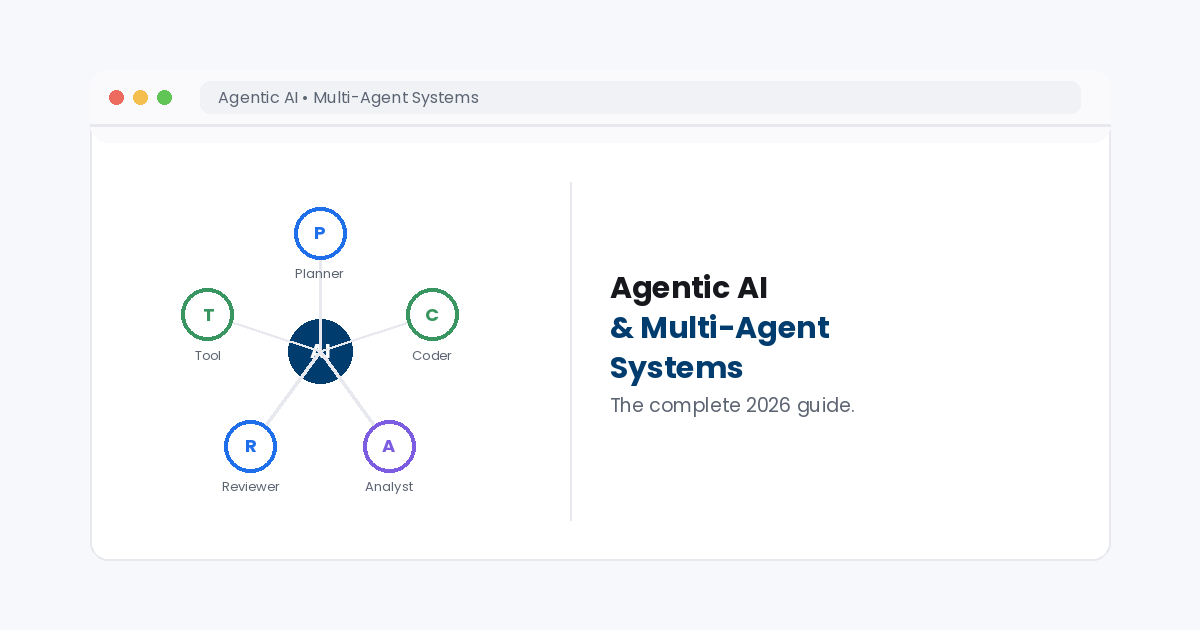
One goal in. A team of specialized agents out. This is how agentic ai actually works.
Agentic ai is the biggest shift in artificial intelligence since chatbots. Unlike a chatbot, it does not just answer questions. Instead, it takes a goal, builds a plan, and acts on its own. Multi-agent systems take this further. Rather than one AI doing everything, a team of specialized agents splits the work. This guide explains agentic ai and multi-agent systems in plain English, backed by real 2026 data.
The short answerAgentic ai is AI that plans, acts, and adjusts on its own to reach a goal, instead of just answering one question. Multi-agent systems split a big task across several specialized agents, the same way a real team splits work among specialists. Together, they mark a shift from AI that talks to AI that does.
1.What is agentic ai?
A chatbot answers one question at a time. Then, it waits for your next message. Agentic ai works differently. First, you give it a goal. Next, it builds a plan and takes action. After that, it checks its own result, adjusts, and tries again. This loop repeats until the task is done. As a result, no human has to guide each step.
Agentic ai already writes code, books meetings, and handles support tickets end to end. In other words, it does not just draft a reply. It completes the task.
2.What are multi-agent systems?
One agent rarely handles a complex job alone. Instead, multi-agent systems split the job. One agent plans the work. Meanwhile, another writes the code. A third then reviews it, while a fourth talks to outside tools. Each agent has one clear role.
This mirrors how expert teams work. After all, a single generalist is slower than a coordinated team of specialists. Therefore, multi-agent systems apply that same logic to software. Engineers call this shift the “microservices moment” for AI: big, all-purpose agents are giving way to smaller, focused ones that work as a team.
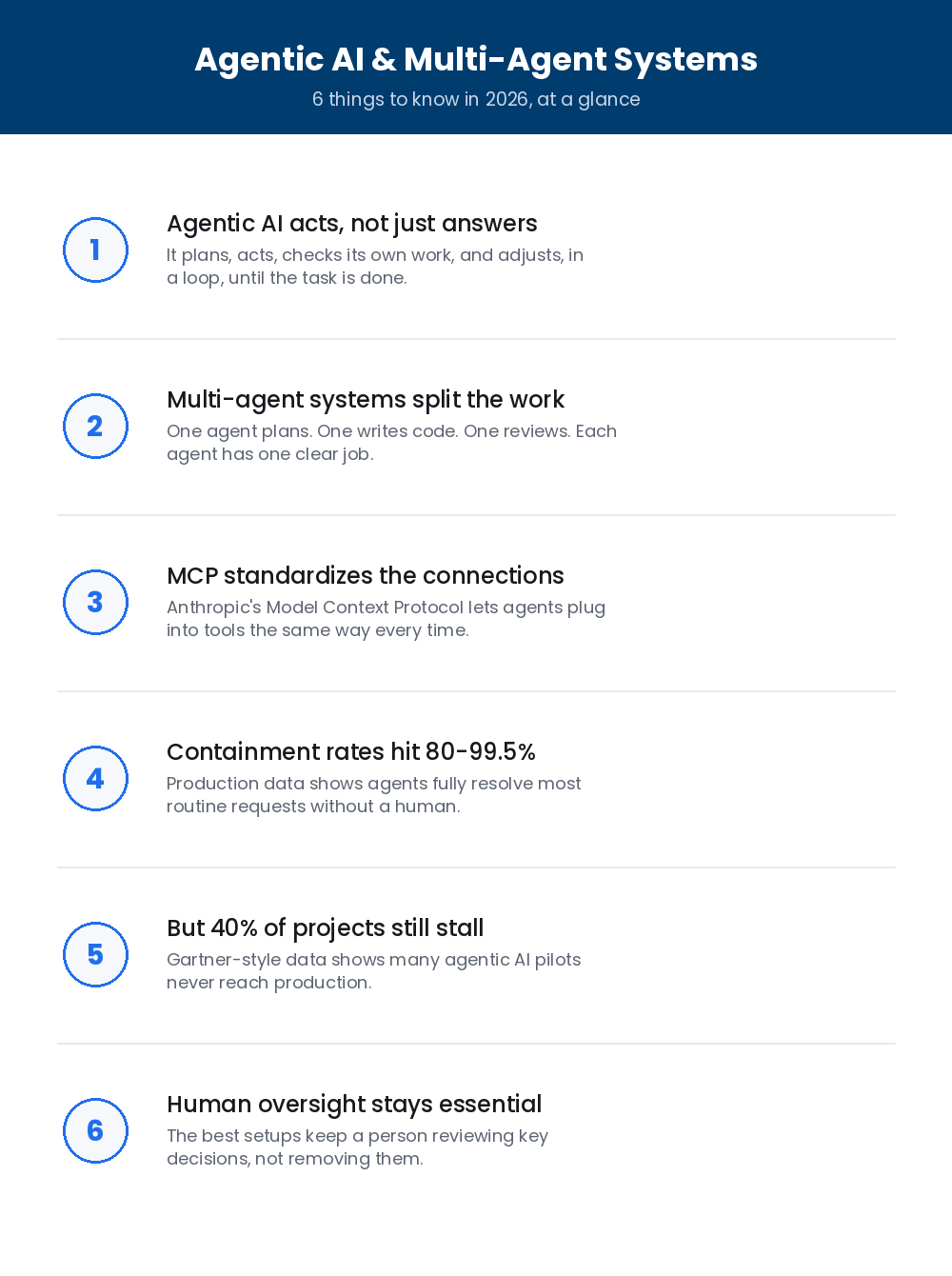
Agentic ai and multi-agent systems, summarized in six points.
3.The protocol behind the scenes: MCP
Every agent needs to use outside tools. For example, it might search the web, run code, or read a file. Back in 2023, every framework built this connection its own way. As a result, code written for one tool did not work with another.
Anthropic fixed this in late 2024 with the Model Context Protocol, or MCP. Essentially, MCP gives agents one standard way to connect to tools and data. By 2026, most production agents use it. Meanwhile, Google built a companion protocol, called A2A, so agents from different companies can talk to each other too.
4.Real numbers: adoption and results
Multi-agent systems are not just a research idea anymore. In fact, production data backs them up. In healthcare, for instance, AI agents now fully resolve 87% of patient service interactions on their own, from identity checks through booking. In HR and IT support, that number reaches 93%. Overall, containment rates across industries range from 80% to 99.5%, depending on the task. These are real production figures, not lab demos.
5.The risk nobody talks about enough
Despite the strong numbers, agentic ai has a real failure rate too. Many pilots never reach production. Some researchers cite a failure rate near 40% for agentic ai projects. The most common cause is not the AI model itself. It is the data behind it.
Roughly 70% of enterprises only discover gaps in their data infrastructure after launching an AI agent project. The agent is ready. The data is not. This is exactly why governance frameworks for agentic ai have become a serious research topic. Researchers often call this approach trust, risk, and security management. It is no longer an afterthought.
6.Popular frameworks in 2026
If you want to build with agentic ai, a few frameworks lead the field this year:
- LangChain and LangGraph — a widely used, general-purpose orchestration toolkit with a large ecosystem.
- AutoGen (Microsoft) — built specifically to help multiple agents cooperate on one task.
- CrewAI — focused on role-based, multi-agent teams that mirror a real org chart.
- MCP-based custom agents — increasingly common now that MCP has become the default connection standard.
Each framework helps you build agents faster. However, none of them replace the need for good data and a clearly defined task. That part is still on you. For a deeper look at where all this AI investment is actually going, see our guide to the AI spending surge.
7.What this means for your business
You do not need to build a multi-agent system from scratch. Most businesses do not need one yet. Start smaller instead. Pick one repetitive task. Use a single, well-defined agent for it. Measure whether it actually saves time. Only then consider adding more agents.
The same lesson applies here as with any new technology: the tool matters less than the task you point it at. For wider industry coverage, see this agentic AI trends analysis from MachineLearningMastery. This 2026 multi-agent adoption benchmark from Druid AI is the source for the containment-rate data cited above.
Frequently asked questions
What is the difference between agentic ai and a chatbot?
A chatbot answers one message at a time and waits for you. Agentic ai takes a goal, plans steps, acts, and checks its own work, often without waiting for your next instruction.
What is a multi-agent system in simple terms?
It is a team of AI agents, each with one job, working together on a bigger task. One agent might plan, one might execute, and one might review the result.
Is agentic ai actually reliable in production?
In many narrow, well-defined tasks, yes, with containment rates above 80%. However, roughly 40% of broader agentic ai projects still fail to reach production, often due to data gaps rather than the AI itself.
Curious whether agentic ai fits your business?
TekShove’s Web Development team can help you pick one real task worth automating, and build it right the first time, without the hype.
Talk to Our Team
Tell us what you need help with and our team will get back to you.