From warehouse floors to factory lines, ai-powered physical robots stopped being a demo in 2026.
AI-powered physical robots are not the same as the robots of ten years ago. Older robots followed one fixed, pre-programmed path. Today’s robots sense the world around them, reason about what they see, and adjust their actions in real time. This guide explains ai-powered physical robots in plain English, backed by real 2026 deployments and numbers.
The short answerAI-powered physical robots use artificial intelligence to sense, decide, and act in the real world, instead of just following a fixed script. In 2026, they already build cars, sort warehouse packages, and clean airplane cabins. However, they still perform noticeably worse outside carefully controlled lab conditions, so most real deployments today are narrow and closely supervised.
1.What makes ai-powered physical robots different?
A traditional industrial robot repeats the same motion every time. It cannot adapt if something moves. An AI-powered physical robot works differently. It uses cameras and sensors to see its surroundings. Then, it reasons about what to do next. Finally, it acts, checks the result, and adjusts if needed.
Industry researchers call this combination “physical AI.” In short, it is the difference between a robot that follows instructions and one that makes decisions. Traditional robots are built for a single, unchanging task on a factory line. AI-powered physical robots, by contrast, are built to handle variation, since real workplaces rarely stay perfectly consistent.
2.Inside a real factory deployment
BMW ran a genuine, extended test of this idea. At its Spartanburg plant, two Figure AI humanoid robots worked for 11 months on the production line. During that time, they helped build over 30,000 BMW X3 vehicles. They also loaded more than 90,000 sheet metal components. As a result, BMW expanded the program to a European plant, its first outside the United States.
This matters because it is not a trade-show demo. It is a full production run, measured in real vehicles and real hours. Over roughly 1,250 operational hours, the robots worked alongside human staff on standard weekday shifts, not in a specially staged environment. That distinction is exactly why manufacturers now treat ai-powered physical robots as a genuine production tool, rather than a research curiosity to revisit later.
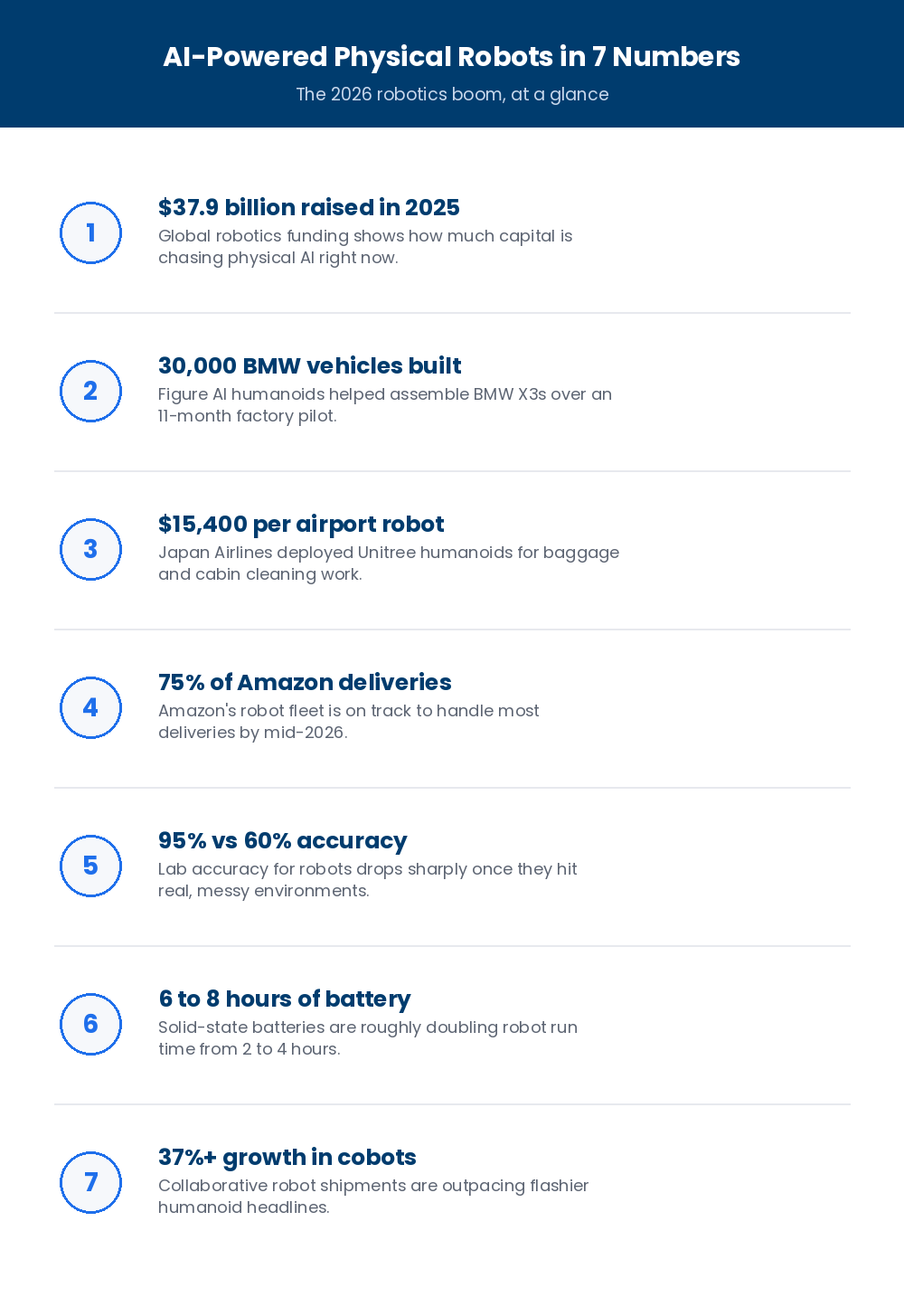
AI-powered physical robots in 2026, summarized in seven numbers.
3.Warehouses and airports: robots at work today
Factories are not the only place these robots show up. Amazon’s robot fleet, including its Sequoia system, is on track to handle roughly 75% of the company’s deliveries by mid-2026. Meanwhile, Japan Airlines began trialing humanoid robots from Unitree, priced at about $15,400 each, for baggage handling and cabin cleaning. Airports were built for people, not machines on wheels, so a humanoid shape fits the existing space without any redesign.
Warehouses tell a similar story. Amazon now operates a fleet of more than one million robots across its facilities worldwide. Most of these are not humanoids at all. They are simpler wheeled or armed machines, each doing one narrow job well. This pattern shows up again and again: the flashiest ai-powered physical robots get the headlines, while quieter, task-specific machines actually do most of the real work.
4.The gap between the lab and the real world
Not every number behind ai-powered physical robots is good news. In controlled lab tests, many robots reach around 95% accuracy. However, that figure can drop to roughly 60% once the same robot works in a real, messy environment. Lighting changes, objects move, and floors are uneven. Consequently, most companies still deploy these robots on narrow, well-defined tasks rather than open-ended ones.
5.Why cobots are quietly winning
Unlike humanoids, cobots are usually a single arm bolted to a workstation. They are cheaper and simpler. They are also easier to trust with a repetitive task today. For more detail, see this Automate 2026 industry recap from Packaging World. This 2026 humanoid robotics market overview from KraneShares covers where the funding behind ai-powered physical robots is actually going.
What this means for your business
Most businesses do not need a humanoid robot in 2026. That said, the underlying idea still applies at a smaller scale. Look for one narrow, repetitive, physical task in your operation. Then, ask whether a simpler, AI-assisted tool, not necessarily a robot, could handle it reliably. Start small, measure the result, and expand only if it actually works. This is the same lesson we cover in our guide to agentic ai and multi-agent systems, just applied to hardware instead of software.
Frequently asked questions
What makes a robot an AI-powered physical robot instead of a normal robot?
A normal industrial robot follows a fixed, pre-programmed path. An AI-powered physical robot senses its environment and reasons about what it sees. Then, it adjusts its actions in real time, without a human rewriting its instructions.
Are humanoid robots actually deployed in real businesses in 2026?
Yes, in growing numbers. BMW ran Figure AI humanoids on a real production line for 11 months, and Japan Airlines uses humanoid robots for baggage and cabin cleaning work. Full-scale deployment is still early, but it is no longer just a lab demo.
Why do AI-powered physical robots perform worse outside the lab?
Lab tests use controlled lighting, layouts, and objects. Real environments are messier and less predictable, so accuracy that hits 95% in a lab can drop to around 60% in the field.
Wondering if automation fits your business?
TekShove’s Web Development team can help you separate genuinely useful AI and automation tools from the trade-show hype.
Talk to Our Team
Tell us what you need help with and our team will get back to you.