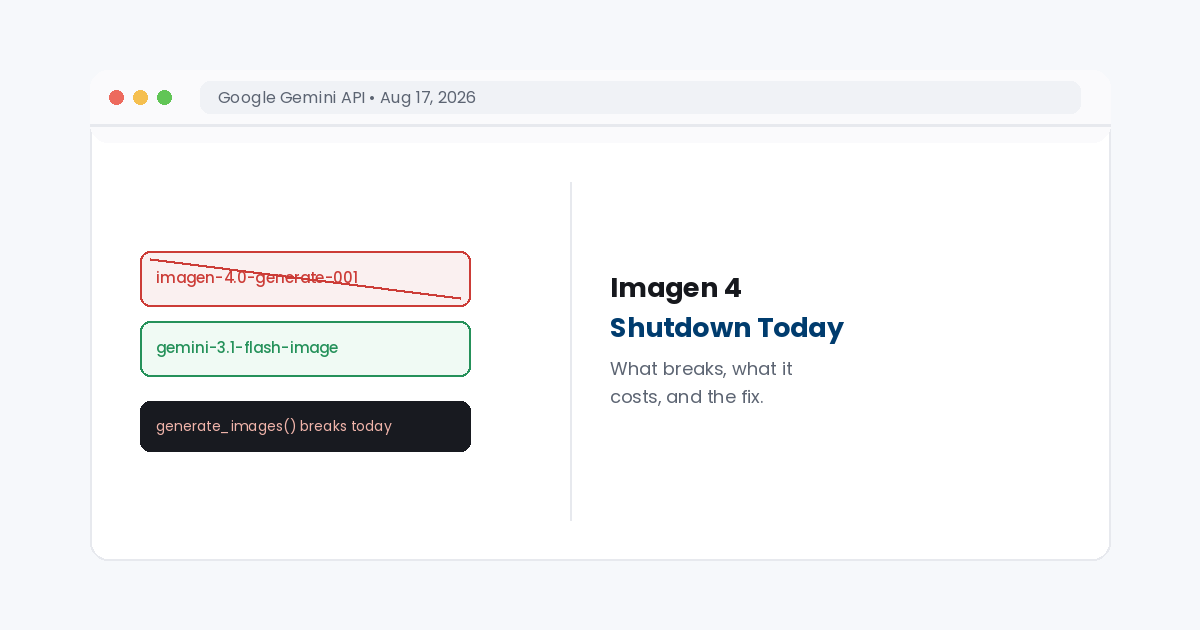
One model retired. One replacement live. The imagen 4 shutdown, in a single image.
If your app calls Google’s Imagen 4 API, today is the day it stops working. The imagen 4 shutdown hits all three stable model IDs on the Gemini Developer API. Google is treating this as a hard cutoff, not a soft warning. This guide covers exactly what breaks, what the real replacement costs, and how to migrate without losing a production app along the way.
The short answer
The imagen 4 shutdown hits all three Imagen 4 model IDs on the Gemini Developer API today, August 17, 2026. This isn’t a simple rename. The oldgenerate_images()method doesn’t carry over, so real code changes are needed. The recommended replacement,gemini-3.1-flash-image, costs roughly 67% more at standard resolution, though the Batch API brings pricing below Imagen 4’s old rate. In exchange, you gain conversational editing, search grounding, and output up to 4K.
1.What’s happening today
The imagen 4 shutdown hits three specific model IDs today: imagen-4.0-generate-001, imagen-4.0-ultra-generate-001, and imagen-4.0-fast-generate-001. Google’s own deprecation page lists August 17, 2026 as the earliest possible shutdown date. It does not name an exact hour. So, it’s safer to treat the cutoff as active from the start of the day. Google states its rule plainly. Once a model shuts down, it is fully turned off. There’s no grace period once that happens.
2.Why the imagen 4 shutdown isn’t a drop-in swap
The recommended replacement is gemini-3.1-flash-image. It’s part of the Gemini image model family, sometimes called “Nano Banana.” Swapping the model name alone won’t work here. Instead, the generate_images() method that Imagen used doesn’t carry over to the new models. That means real code changes, not just a small config edit. Teams should test aspect ratios, safety settings, and output quality first. Notably, prompts built for Imagen don’t always work the same way on the new model.
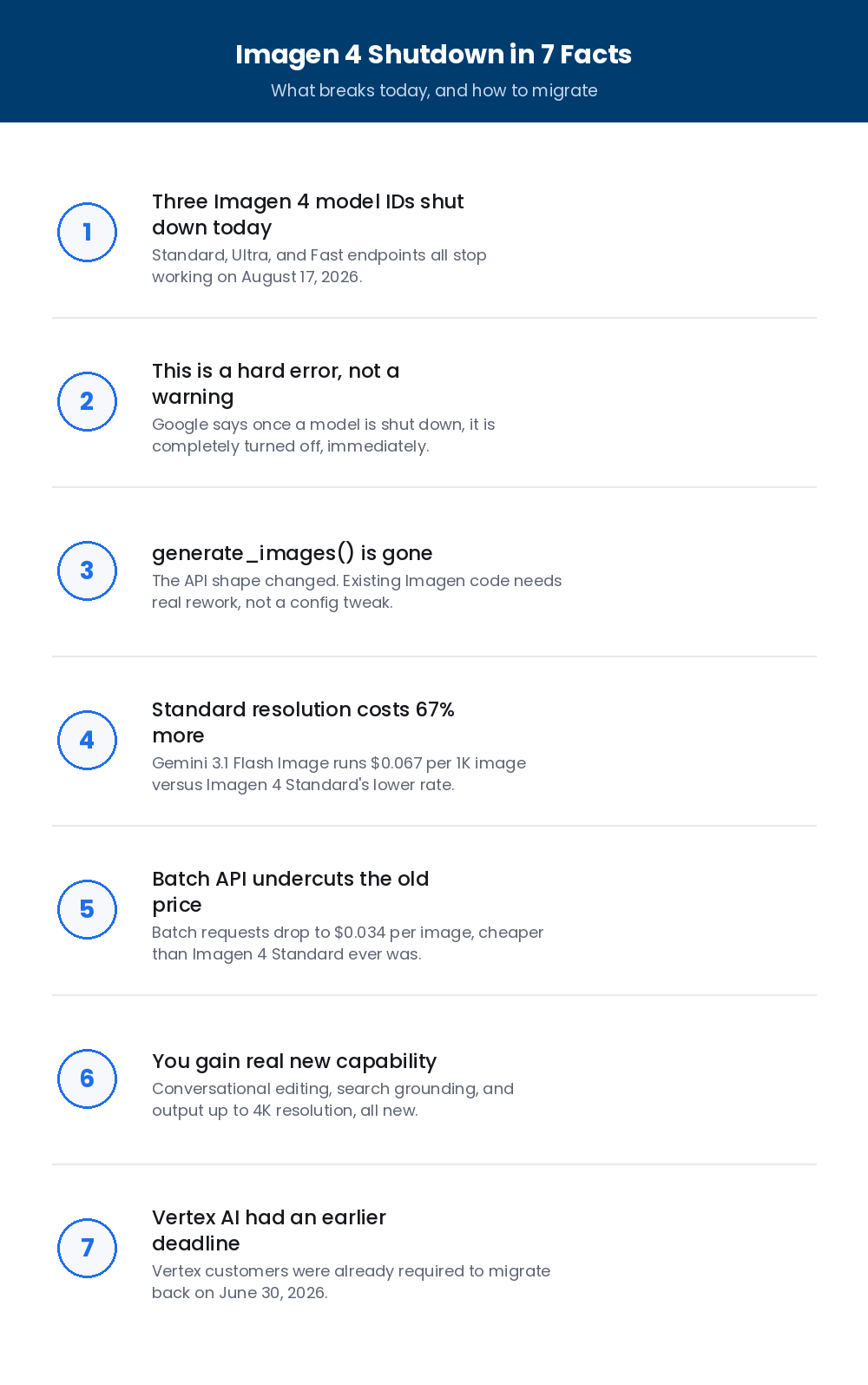 The imagen 4 shutdown, the real facts behind today’s change.
3.The real cost of the imagen 4 shutdown
Pricing changed shape entirely. Imagen 4 charged a flat rate per image, based on model tier. Gemini 3.1 Flash Image instead prices by token, which scales with size. At standard list pricing, that works out to roughly 67% more per image than Imagen 4 Standard cost. There’s a real workaround, though. Switching to the Batch API drops the price to about $0.034 per image. That actually beats Imagen 4 Standard’s old rate. At full 4K output, cost climbs to $0.151 per image. Notably, size choices now directly affect your bill in a way they didn’t before.
Running an app that still calls the Imagen API?
We’ll help you scope the real migration work and cost impact before anything breaks in production. Overall, that upfront planning saves far more time than reacting after the fact.
4.What you gain from the imagen 4 shutdown
The migration isn’t purely a cost story. Gemini 3.1 Flash Image accepts text, image, and video as input context, not just a text prompt. It supports back-and-forth editing, where you can refine an image through follow-up instructions instead of writing a brand new prompt each time. Beyond that, it also supports search grounding and video-to-image work, plus output resolution up to 4K, well beyond what Imagen 4 offered. For teams building genuinely interactive image tools, these are real new features, not just a like-for-like swap.
5.Vertex AI versus the Gemini API
This detail trips up a lot of teams, so it’s worth stating clearly. The August 17 date covers the Gemini Developer API specifically. Vertex AI runs on a separate lifecycle entirely. Google had already told Vertex customers to move their Imagen setups earlier, by June 30, 2026. If you’re unsure which surface your app actually uses, check your API endpoint and login method first. Do this before you assume today’s deadline does or doesn’t apply to you.
6.A quick migration checklist
Overall, start by finding every place in your codebase that calls an Imagen 4 model ID. Next, swap generate_images() calls for the new Gemini image generation approach, and test against real production prompts, not just simple examples. Then, compare real costs using your real image volume and size mix. Check whether Batch API fits your use case. Finally, add fallback error handling for the changeover window. A hard cutoff with no warning period leaves no room for a silent failure to go unnoticed.
How TekShove handles migrations like the imagen 4 shutdown
API shutdowns like this happen constantly across the AI landscape. They hit real client projects, not just hypothetical ones. Our Web Development team tracks these deprecation timelines and handles migrations before they become production incidents.
For more depth, our guides to AI-powered web development and AI coding tools cover how we build with AI-assisted tools generally. This official Gemini API documentation on Imagen from Google and this coverage of the shutdown and pricing from Bez-kabli cover the original technical details.
Frequently asked questions
When exactly does the Imagen 4 API shut down?
Google lists August 17, 2026 as the earliest possible shutdown date for all three Imagen 4 model IDs on the Gemini Developer API. This covers the standard, ultra, and fast endpoints. Google does not publish an exact hour. Apps should treat the shutdown as active from the start of that day.
Is migrating from Imagen 4 to Gemini image models a simple model name swap?
No. The API shape itself changed. Instead, the generate_images() method used by Imagen no longer applies to the new Gemini image models. Existing integration code needs real updates, not just a changed model name.
Will switching to Gemini 3.1 Flash Image cost more than Imagen 4?
At standard resolution and standard pricing, yes, roughly 67% more per image than Imagen 4 Standard. However, using the Batch API brings the cost down to about $0.034 per image, which is actually cheaper than Imagen 4 Standard ever was.
Need help migrating off a shutting-down API?
TekShove tracks AI platform changes like this and handles the migration work before it becomes a production emergency.
Talk to Our Team
Tell us what you need help with and our team will get back to you.