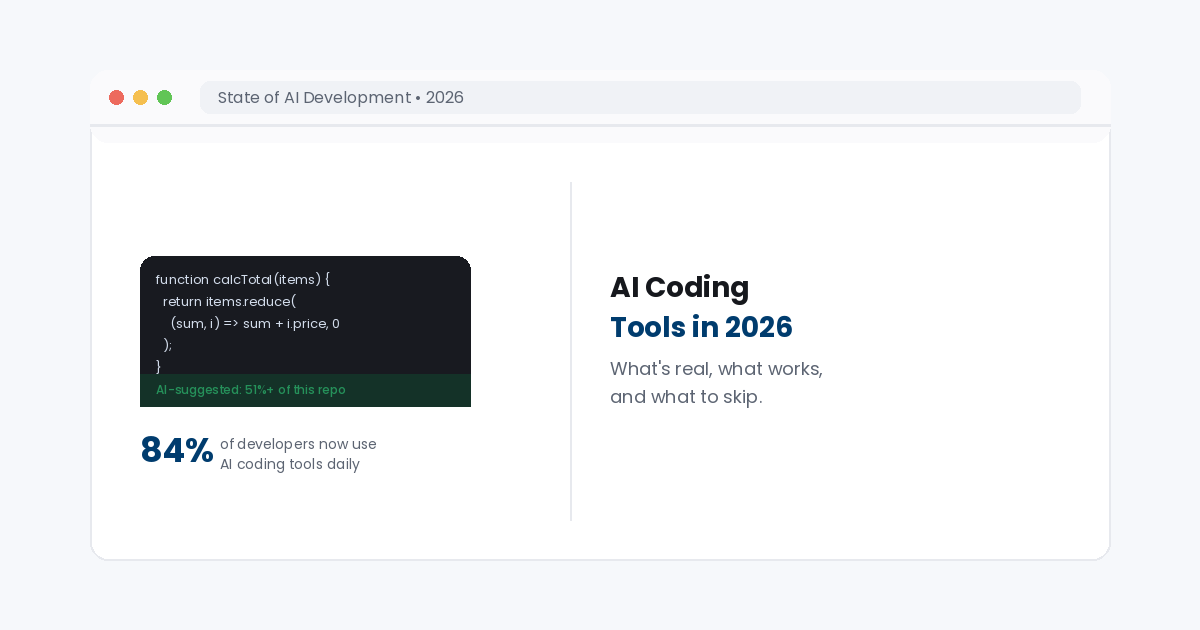
84% adoption. 51% of new code. AI coding tools stopped being optional years ago.
Software development changed faster in the last two years than in the previous decade. AI coding tools now write, test, and review real production code at a scale nobody predicted this soon. This guide covers what’s actually confirmed by the data, which tools are worth paying for, and where human review still genuinely matters.
The short answerAI coding tools are now mainstream. 84% of developers use or plan to use them, and more than half of new GitHub code involves AI assistance. The market has grown to $12.8 billion, with real acquisitions like SpaceX’s $60 billion purchase of Cursor proving the stakes are serious. Still, quality varies a lot between tools, and security review has not fully caught up. Pick the tool that fits your actual bottleneck, not the one with the loudest launch.
1.The numbers behind the shift
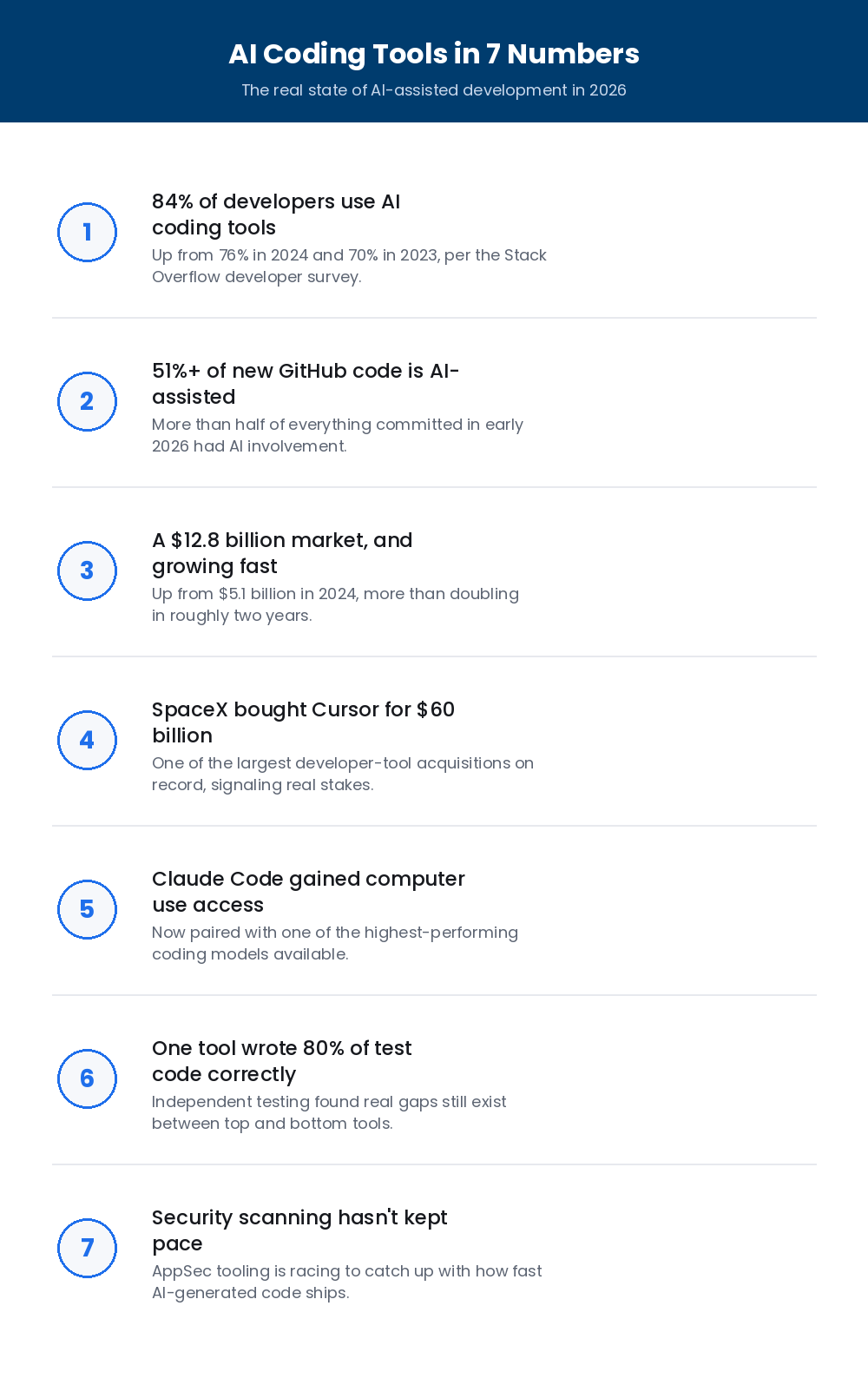
A large developer survey covering more than 49,000 respondents found that 84% of developers now use or plan to use AI coding tools. That is up from 76% in 2024 and 70% in 2023, a steady climb rather than a sudden jump. On GitHub, meanwhile, more than 51% of code committed in early 2026 had some AI help. The tools market itself has grown to an estimated $12.8 billion, up from $5.1 billion in 2024. Two years ago, this was still a novelty. Now, it touches most of the $600 billion global software industry.
2.What changed this year
Two developments reshaped the competitive picture in July 2026 alone. SpaceX bought Cursor for a reported $60 billion. That is one of the largest developer-tool deals on record. Meanwhile, Claude Code gained computer use skills, paired with access to one of the top coding models available. Neither change replaced the existing leaders outright. Instead, both moves show how much money and strategic weight now sits behind this category.
 AI coding tools in 2026, the real numbers behind the boom.
3.The current tool leaderboard
OpenCode currently holds the top spot among open-source coding agents, with over 160,000 GitHub stars and 7.5 million monthly active developers. Claude Code leads among premium autonomous coding agents, especially for multi-step tasks that run with less supervision. Meanwhile, GitHub Copilot and Cursor remain the most widely used in-editor assistants. Tools like Codeium and Amazon Q, in contrast, serve teams already committed to a specific cloud ecosystem. No single tool wins every category. That is exactly why matching the tool to the task matters more than chasing whichever one trends this month.
Not sure which AI coding tools actually fit your team?
We use these tools in our own development work daily. Overall, let’s talk through what genuinely matches your workflow and budget.
4.What these tools are actually good at
The strongest use cases are consistent across most tools. Boilerplate code, test generation, and routine bug fixes are where AI coding tools save the most real time. Documentation and pull request summaries follow close behind, since these tasks are tedious but well-defined. In one head-to-head test, notably, a leading tool wrote 80% of test code correctly on the first try. That is a genuinely strong result. Still, it also means one in five outputs needed a human fix. That is worth remembering before trusting any tool blindly.
5.The honest gap: where review still matters
Adoption numbers do not mean every output is safe to ship untouched. Independent testing keeps finding real quality gaps between the strongest and weakest tools. Security tooling has been racing to catch up with how fast AI-written code now ships. Notably, older scanners were simply not built for this much code this fast. New agentic security tools are emerging to watch AI-written code in real time. For now, human review before launch remains the safest default, not an optional extra step.
6.How to adopt this without breaking your codebase
Start with one narrow, well-defined task rather than rolling out a tool across your whole team at once. Test generation or documentation are safer starting points than production logic. Keep a real person reviewing anything security-sensitive, no matter how good the tool’s track record is. Track real outcomes, not just adoption. A tool that saves time but adds bugs is not actually saving you anything. For a deeper look at reliable agent-based coding workflows, see our guide to loop engineering.
What this means for your business
You do not need to adopt every new AI coding tool the moment it launches. Instead, you need a clear plan for which parts of your development process actually benefit. Some parts still need a careful human hand.
Related decisions matter too. Our guides to the right tech stack and cross-platform app development cover picking the right technology for your specific business. This AI dev tool power ranking from LogRocket and this head-to-head benchmark from Tech Insider cover the full rankings and methodology.
Frequently asked questions
How many developers actually use AI coding tools in 2026?
84% of developers now use or plan to use AI coding tools, according to a large developer survey covering more than 49,000 respondents. That is up from 76% in 2024 and 70% in 2023.
Is AI-generated code actually safe to ship to production?
It depends heavily on review process, not the tool alone. Independent testing shows real gaps between the best and worst tools. Security scanning has not fully caught up with how fast AI-generated code now ships. Human review still matters, especially for security-sensitive code.
Which AI coding tool should a small team actually pay for?
There is no single right answer. Instead, match the tool to the actual bottleneck. A coding agent fits autonomous multi-step tasks. An in-editor assistant fits day-to-day suggestions. A testing-focused tool fits teams where quality assurance is the real gap.
Building software and want the right AI tools in the mix?
TekShove uses AI coding tools in our own builds, with real human review at every step. Let’s talk about your project.
Talk to Our Team
Tell us what you need help with and our team will get back to you.