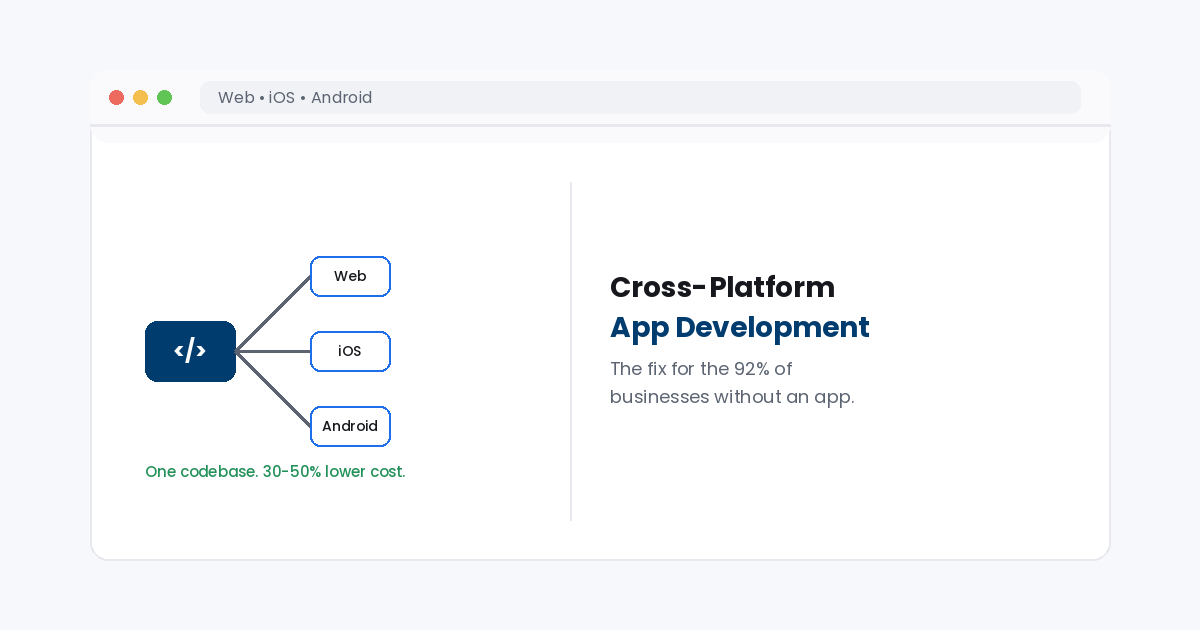
One codebase. Three platforms. Cross platform app development in a single picture.
Most small businesses know they should have an app. Almost none of them do. Recent research puts the number at 92%: the vast majority of small businesses worldwide still don’t have a dedicated mobile app in 2026. The usual reasons are cost, technical skill, and doubt about return on investment. Cross platform app development solves all three at once, and this guide explains exactly how.
The short answerCross platform app development means writing one codebase, usually in Flutter or React Native, that runs on both iOS and Android. It costs 30 to 50 percent less than building two separate native apps. This matters because 92% of small businesses still don’t have an app, even though customers now spend most of their mobile time inside apps, not browsers. For a lighter option, a Progressive Web App skips the app store entirely.
1.The real problem: the small business app gap
Recent surveys show that about 92% of small businesses globally still don’t have a dedicated mobile app. Most rely only on a website or social media instead. Ask business owners why, and three answers come up again and again. Development feels too expensive. Technical staff to manage it are hard to find. And most owners aren’t sure an app would pay for itself. Each of those concerns is reasonable on its own. Together, they’ve created what researchers now call the small business app gap.
2.Why this actually matters now
Customer behavior has shifted more than most owners realize. Over 5.7 billion people now use a smartphone worldwide. Notably, roughly 88% of mobile time is spent inside apps, not web browsers. That means a business without an app is invisible during most of the time its customers actually spend on their phones. Mobile commerce has grown alongside this shift, and the gap between customer expectations and small business reality keeps widening every year this goes unaddressed.
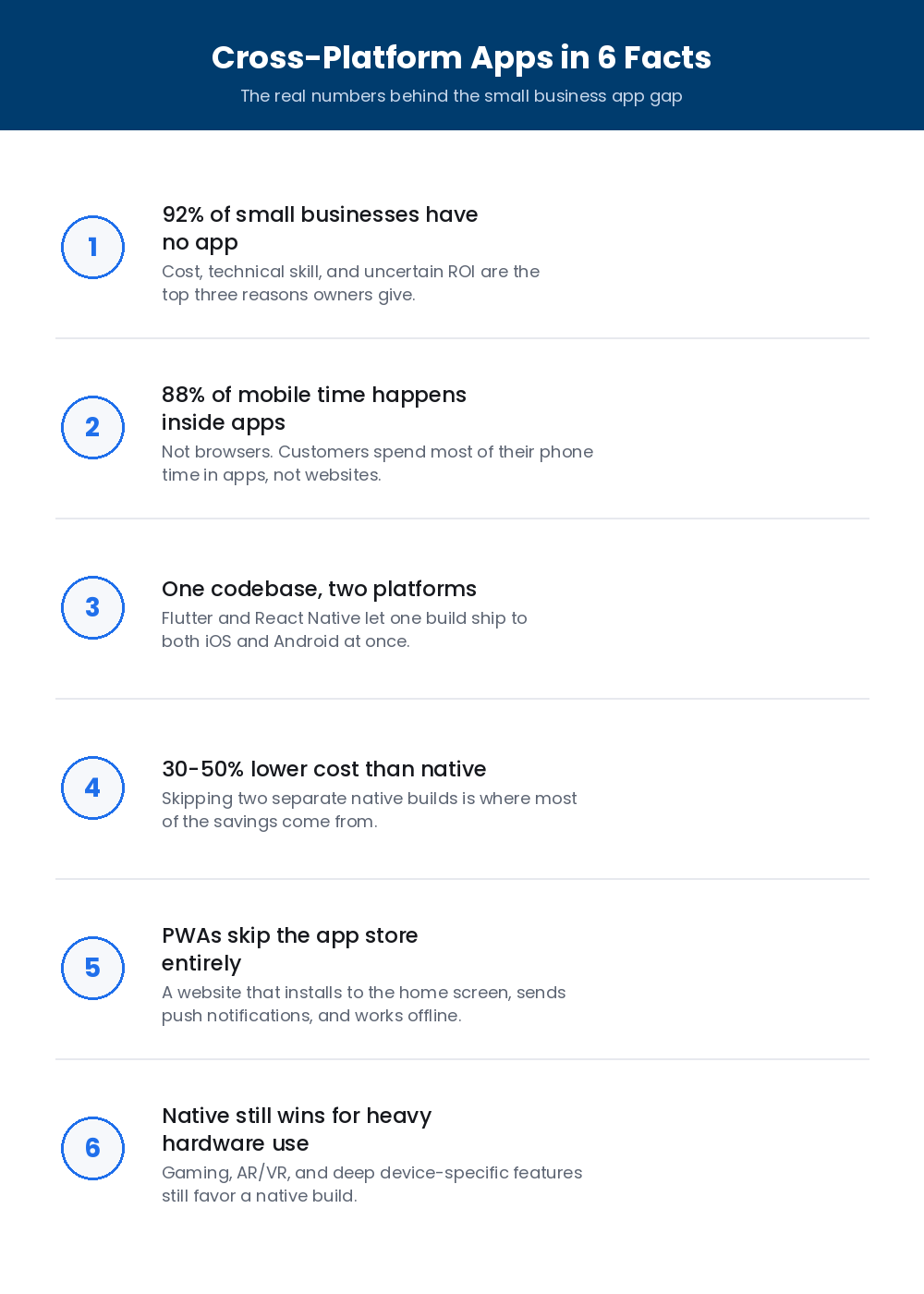 Cross platform app development, the real numbers behind the gap and the fix.
3.What cross-platform app development actually is
Traditionally, reaching both iPhone and Android users meant building two separate apps: one in Swift for iOS, one in Kotlin for Android. Cross platform app development changes that. Frameworks like Flutter and React Native let a team write one codebase that compiles into apps for both platforms at once. Notably, performance differences compared to fully native apps are now small, typically 5 to 15%, which is a fair trade for most business use cases. Frameworks like these now cover roughly 90% of real-world business app needs.
4.The real cost savings
The financial case is the clearest part of this story. Cross platform app development typically costs 30 to 50% less than building two separate native apps. A custom native app project often runs $50,000 to $150,000 or more per platform. Cutting that to one shared build, instead of two, is where most of the savings come from. For a small business testing whether an app is worth the investment, that lower entry cost changes the calculation entirely.
Free consultation
Not sure if your business actually needs an app yet?
We’ll walk through your customers, your budget, and your goals honestly. Then we’ll tell you whether a cross-platform app, a PWA, or neither makes sense right now.
5.When cross-platform is not the right choice
Cross platform app development is not the answer for every project. Apps that lean heavily on advanced hardware, graphics-intensive games, or deep AR and VR features still perform best built natively. Businesses that already run separate, well-funded iOS and Android teams may also have less to gain from switching. That said, these situations cover a relatively small share of real business apps. Most everyday tools, from booking systems to loyalty apps to service catalogs, fit cross-platform development well.
6.PWAs: an even lighter alternative
A Progressive Web App, or PWA, takes a different approach entirely. It’s a website built with modern browser technology to behave like a native app. Customers install it straight from their browser to their home screen, skipping the app store review process completely. A PWA can send push notifications and work offline, much like a real app. It won’t cover every native feature. Still, for a business that needs to launch fast on a lean budget, it’s often the fastest path from nothing to something.
What this means for your business
You don’t need to close the entire small business app gap overnight. Start by deciding what problem an app would actually solve: bookings, loyalty, faster ordering, or something else specific to your customers. Then, match the build to that need. Sometimes a PWA is enough. Other times a cross-platform app is the right call. Either way, cross platform app development has made this decision far more affordable than it was even a few years ago. For more detail, see this mobile app development cost guide from Cynoteck and this small business app gap research from AppNatively.
Frequently asked questions
What is cross-platform app development?
Cross platform app development means writing one codebase, usually with a framework like Flutter or React Native, that runs on both iOS and Android. It skips the cost and time of building two separate native apps.
How much cheaper is cross-platform app development than building two native apps?
Cross platform app development typically costs 30 to 50 percent less than building separate native iOS and Android apps. One codebase covers both platforms instead of two full development efforts.
What is a Progressive Web App and how is it different from a cross-platform app?
A Progressive Web App, or PWA, is a website built to behave like an app. Users install it from their browser instead of an app store, and it can send push notifications and work offline. It is lighter and cheaper than a true cross-platform app, but with fewer device-level capabilities.
When should a business choose native development instead of cross-platform?
Native development still makes sense for apps that rely heavily on advanced hardware, graphics-intensive experiences like gaming, or deep AR and VR features. For most everyday business apps, cross-platform covers the need well.
Ready to close your own app gap, affordably?
TekShove can help you decide between a PWA, a cross-platform app, or a native build, then build it right the first time.
Talk to Our Team
Tell us what you need help with and our team will get back to you.