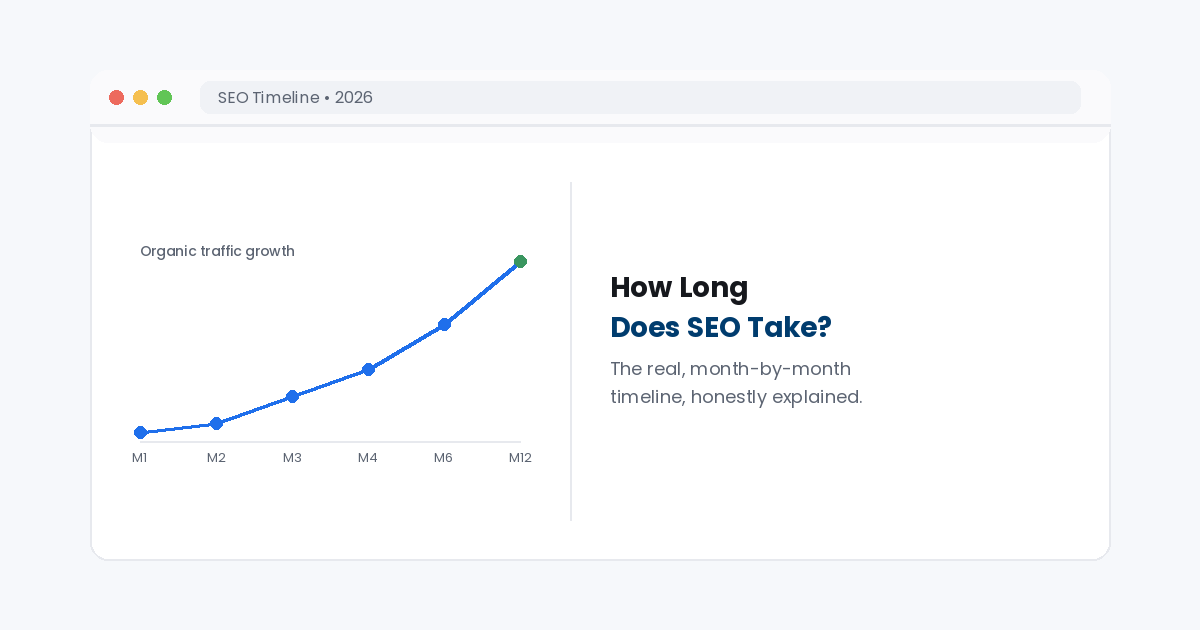
The curve always looks flat at first. Then it doesn’t. Here is how long that actually takes.
Every client asks how long does SEO take, usually in the first meeting. It is a fair question. You are spending real budget, and you want proof it works. The honest answer is three to six months for most sites, with Google’s own guidance pointing to four months to a year for significant results. Overall, this guide breaks that timeline down month by month, so you know exactly what should be happening at each stage, and why patience here is not the same as wasted time.
The short answerMost websites see measurable SEO results within three to six months. Google’s own guidance points to four months to a year for significant results, and highly competitive industries can take longer. Local SEO tends to move faster, often four to eight weeks. The single biggest factor is whether your site’s technical foundation is solid before content and links start doing their job.
1.How long does SEO take? The short answer
Shopify’s SEO lead puts it simply: most sites can expect measurable results within three to six months. Google Search Advocate John Mueller has said new websites typically need four months to a year before seeing significant results. In fact, around 80% of SEO professionals agree that consistent results require at least six months of ongoing work. None of these numbers are marketing spin. Instead, they reflect how search engines are actually built.
2.Months 1-2: the invisible foundation
The first two months rarely produce visible rankings, and that is normal, not a warning sign. Still, real work happens here anyway: a technical audit, keyword research, fixing crawl errors, and setting up tracking in Google Search Console. A site with broken links or duplicate content needs this phase resolved before anything else can work. Skipping it does not save time. Instead, it just delays the same work to a later, more expensive stage.
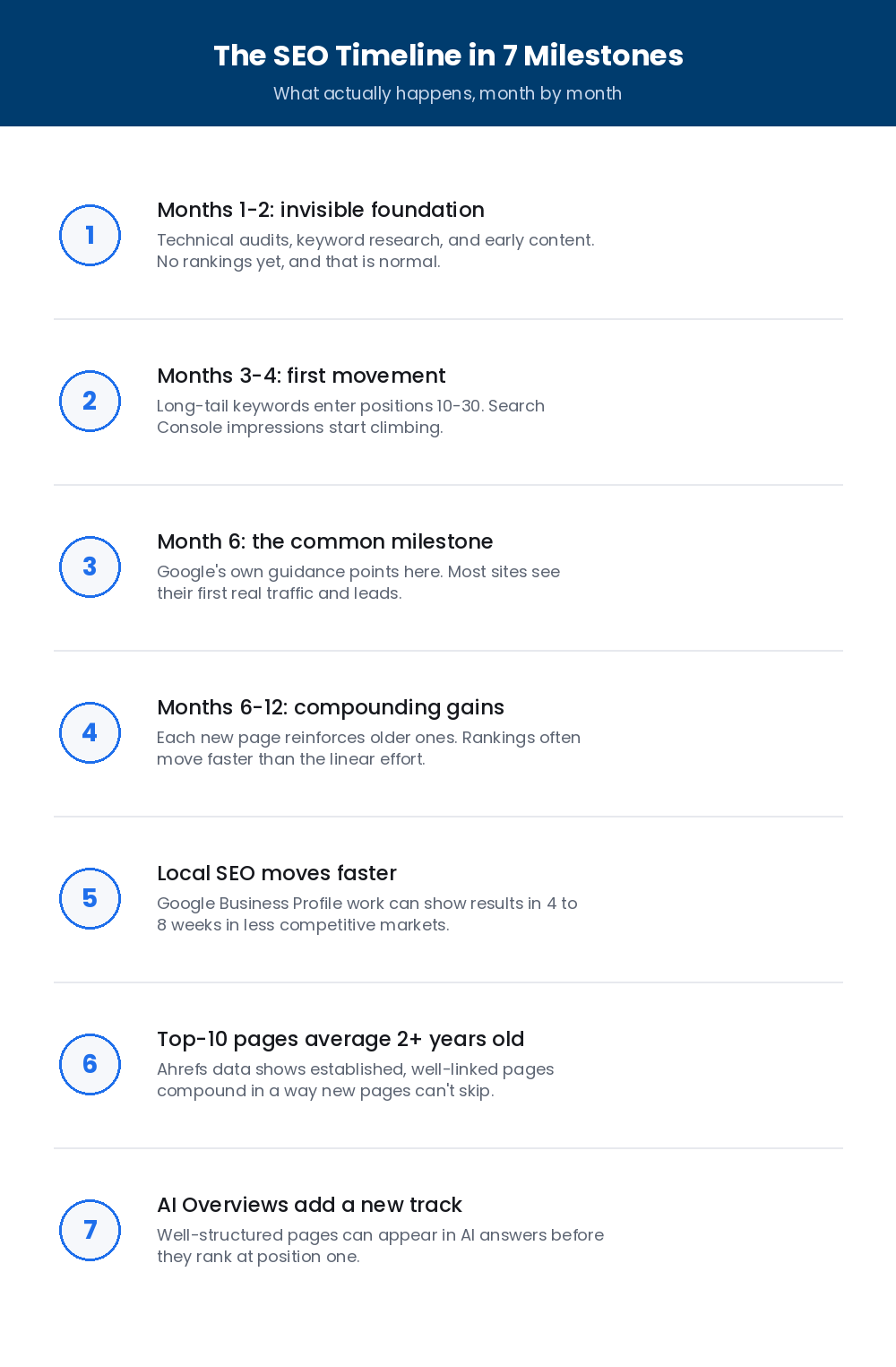 How long does SEO take, broken into seven real milestones.
3.Months 3-4: the first real movement
This is where most campaigns start showing life, and where how long does SEO take stops feeling like an abstract question. Long-tail keywords begin entering positions 10 through 30. Meanwhile, impressions in Search Console climb week over week. Some sites land their first page-one ranking for a specific local or niche query. Traffic often still feels low at this stage, but the direction becomes clearly positive, which is the real signal worth watching.
4.Month 6: the milestone Google itself names
Six months shows up again and again in independent research answering how long does SEO take. It is the point where SEO starts making a real difference. Steady leads, a first wave of sales, or stable rankings for real keywords all tend to cluster here. However, Ahrefs’ own data adds an important caveat. The average top-10 page is over two years old. Only a small share of new pages reach the top 10 within their first year. Month six is a real milestone, not a finish line.
5.Why Google is slow on purpose
How long does SEO take really comes down to one thing: trust, and trust is not instant. Paid ads buy placement the moment you pay for it. Search rankings work differently, since Google is deliberately resistant to manipulation. A new site starts with no backlink history, no behavioral data, and no track record of consistent quality. All of these are signals Google weighs heavily. If rankings could be bought or rushed, low-quality, spam-driven sites would win constantly. Instead, the delay is the system working as intended, not a flaw in it.
6.What actually speeds up the timeline
A few factors reliably compress how long SEO takes without cutting corners. Starting with a clean technical foundation skips weeks of remedial work later. Publishing consistently, ideally two to four quality posts a month, compounds faster than one big push followed by silence. Overall, backlink quality matters more than volume. A single link from a respected industry publication outweighs dozens from unrelated sites. Our GEO guide to Google AI Mode and AI Overviews covers how this connects to AI-driven discovery too.
7.The 2026 twist: AI Overviews
One thing has genuinely changed the timeline conversation in 2026. Google AI Overviews and similar AI search surfaces create a second, parallel track alongside traditional rankings. A page can appear inside an AI-generated answer before it ever reaches position one organically.
Pages built with FAQ schema and answer-first headings tend to surface faster in these AI answers. Short paragraphs help too. This does not change how long SEO takes overall. It adds a second way results can show up earlier than expected. For more detail, see this SEO timeline research from Shopify and this independent timeline breakdown from SEO.com.
Frequently asked questions
How long does SEO take to show results?
Most sites see measurable results within three to six months. Google’s own guidance points to four months to a year for significant results. Competitive industries and brand-new websites often need six to twelve months or longer.
Why does SEO take so much longer than paid ads?
Paid ads buy placement instantly. SEO requires Google to crawl, evaluate, and build trust in a page over time, which resists manipulation by design. A new site has no track record yet, and that track record is exactly what search engines are built to require.
Can any type of SEO show results faster than 3 to 6 months?
Yes. Local SEO and Google Business Profile optimization often show results within 4 to 8 weeks, especially in less competitive markets. National and highly competitive keywords face far more competing signals.
Ready to start the clock on real SEO results?
TekShove’s SEO Marketing team builds the technical foundation, content, and links that move you through this timeline as fast as it can honestly go.
Talk to Our Team
Tell us what you need help with and our team will get back to you.