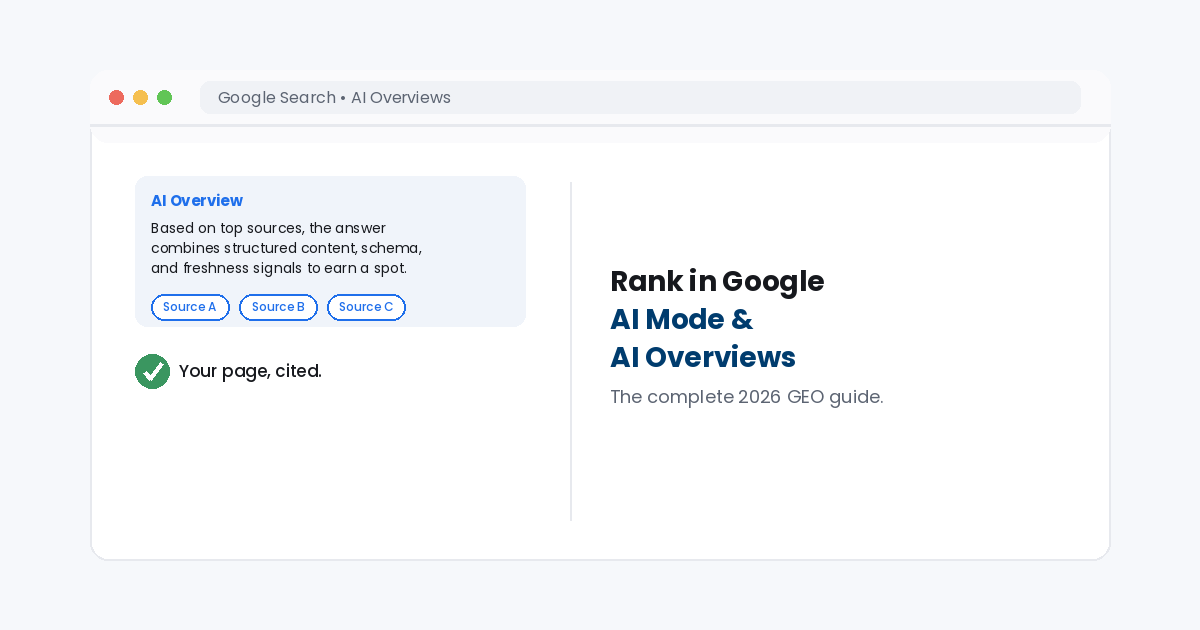
A cited source, three chips, one goal: get your page into the answer, not just the index.
Google AI Mode and AI Overviews now sit at the top of search, ahead of the ten blue links most sites were built for. Both run on Gemini. Both pull from Google’s own index. Getting cited in either takes more than classic SEO alone. It takes Generative Engine Optimization, or GEO: the practice of structuring content so AI systems can extract, trust, and cite it. This guide covers exactly how, backed by real 2026 citation data.
The short answerGoogle AI Mode and AI Overviews both run on Gemini and pull from Google’s regular search index. To get cited, first rank organically in the top 10 to 20 results. Then, structure your content to answer the full range of related questions, not just one keyword, and back every claim with real data, schema, and a named author. Freshness matters too, since most citations come from recently published or updated pages.
1.AI Overviews vs. AI Mode: what’s the difference?
AI Overviews is a summary block that appears above the normal search results. The blue links are still there underneath it. AI Mode goes further. It replaces the results page entirely with a conversational, back-and-forth answer. Both surfaces run on the same Gemini model. Both pull from the same index. As a result, the work behind ranking in google ai mode and ai overviews tends to lift both surfaces at once, not just one.
2.Step 1: Rank organically first
There is no shortcut around this step. Roughly 97% of AI Overview citations come from pages already ranking in Google’s top 20 organic results. About 52% of citations go to pages already sitting in the top 10. In other words, GEO does not replace classic SEO. Instead, it sits on top of it. If a page cannot rank normally, it will not enter the pool of candidates Gemini pulls from.
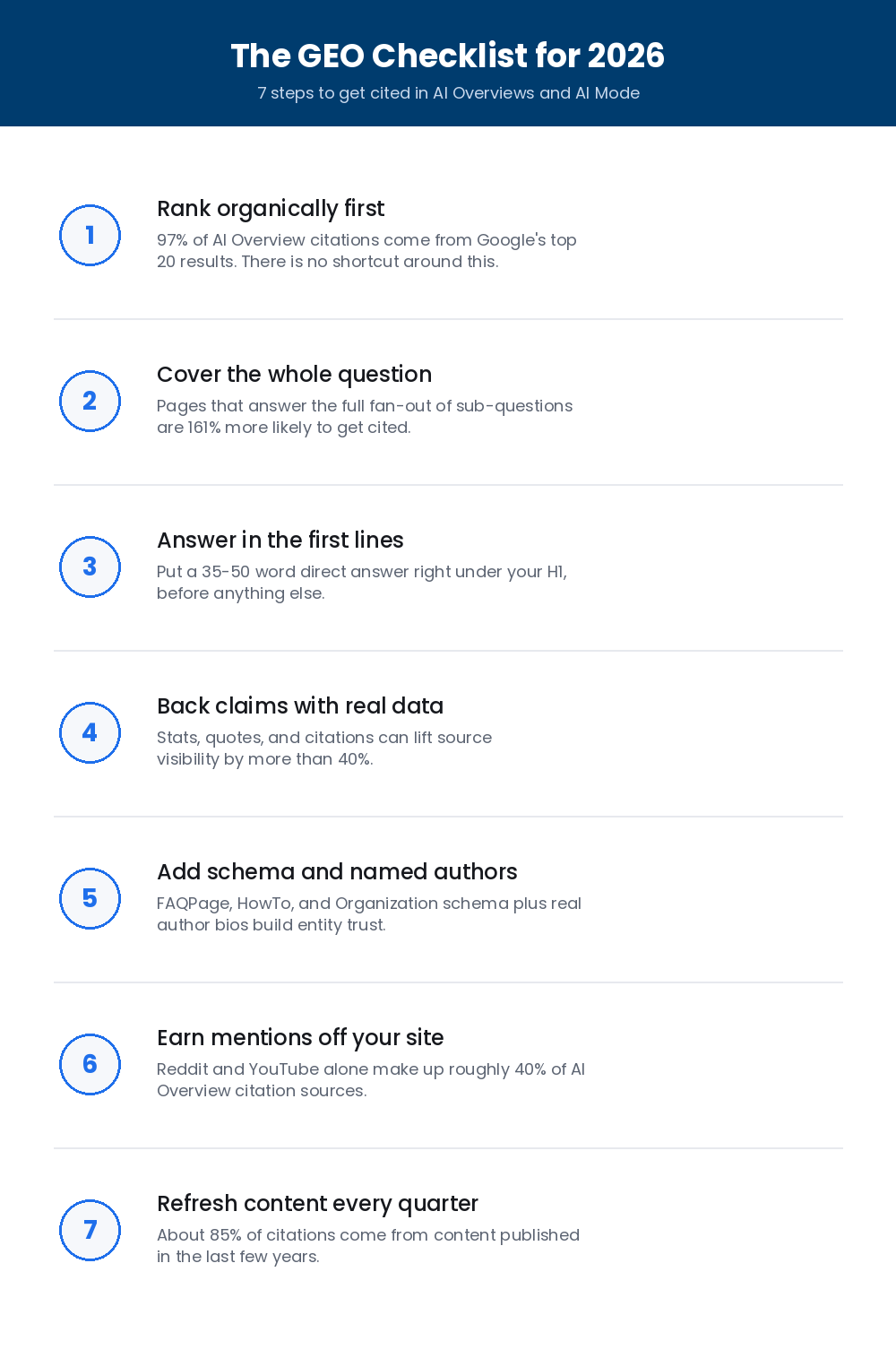
The full GEO checklist, from foundation to ongoing maintenance.
3.Step 2: Master query fan-out
AI Mode rarely answers just the question a person typed. Instead, it silently breaks that question into several related sub-questions, then searches for all of them at once. This is called query fan-out. Pages that happen to answer that whole cluster of sub-questions are 161% more likely to get cited than pages answering only the original query. Practically, this means covering a topic’s full question-space on one page, rather than writing many thin pages for single keywords.
4.Step 3: Format for extraction
Gemini needs to lift a clean passage out of your page, not guess at your meaning. First, start with a direct 35 to 50 word answer right under your H1, before anything else. Then, structure each H2 section as a self-contained passage of roughly 130 to 170 words that could stand on its own if quoted. Overall, question-style headings, followed immediately by a clear answer, consistently perform best.
5.Step 4: Back every claim with data
Vague claims do not survive extraction well. Specific ones do. Academic GEO research from Princeton and the University of Delhi backs this up. Adding citations, quotes, and statistics can lift a source’s visibility in generative answers by more than 40%. Original data, named studies, and real numbers give Gemini something concrete and verifiable to quote.
6.Step 5: Build entity trust with schema
Schema markup tells AI systems exactly who is talking and what the page is about. At minimum, add Organization, Article, and FAQPage schema, plus a named author with a real bio. Third-party corroboration matters too. Reddit and YouTube alone account for roughly 40% of AI Overview citation sources combined. That is because Google favors evidence from beyond your own site. A presence in relevant communities and video content genuinely helps here, not just your own blog.
7.Step 6: Keep content fresh
Recency is a real signal. In one large analysis, roughly 85% of AI Overview citations came from content published within the last few years. The newest year alone accounted for close to half. A full rewrite is not always necessary. Refreshing a page’s statistics, links, and publish date every quarter is often enough to reset its relevance.
For a deeper technical breakdown, see this AI Overviews optimization guide from Search Engine Land. For the full taxonomy, see this 2026 GEO and AI Overviews strategy guide. Together, they cover most of what google ai mode and ai overviews actually reward.
What this means for your business
You do not need a page for every possible query. Instead, pick your highest-value topics, and cover each one thoroughly: organic ranking first, full question coverage second, clean answer formatting third. Also, add schema and a real author to every page. Then, revisit your best-performing content each quarter instead of only publishing new posts. This is the same GEO work our SEO Marketing team builds into every client site.
Frequently asked questions
What is the difference between Google AI Mode and AI Overviews?
AI Overviews is a summary block that sits above the normal blue links, so both still exist on the page. AI Mode replaces the results page entirely with a conversational answer. Both run on Gemini and draw from Google’s own index, so the same optimization work supports both.
Do I need to rank on page one of Google to appear in AI Overviews?
Not always, but it helps enormously. Roughly 97% of AI Overview citations come from Google’s top 20 results, and about 52% already rank in the top 10. Strong organic rankings are the foundation everything else builds on.
Is GEO different from regular SEO?
GEO builds on regular SEO rather than replacing it. Good technical SEO, clear content, and real authority remain the foundation. GEO adds a few extra layers on top, such as answer-first formatting, schema, and structuring content around full topic coverage instead of single keywords.
Not sure if your site is even in the running?
TekShove’s SEO Marketing team can audit your site against this exact GEO checklist and fix the gaps, from schema to content structure. Our Web Development team handles the technical foundation underneath it.
Talk to Our Team
Tell us what you need help with and our team will get back to you.