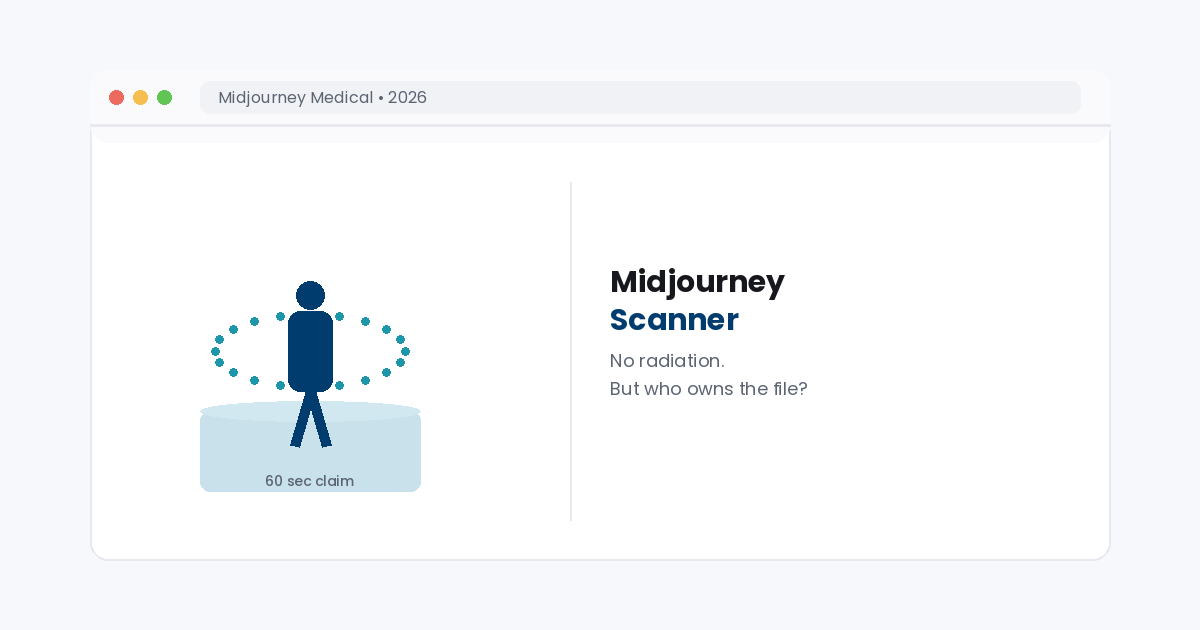
Step into water. Sensors map your muscle, fat, bone, and organs. No radiation. But whose file is it after that?
The Midjourney Scanner is real, and it is a genuinely strange pivot for a company known for AI art. In June 2026, Midjourney announced a full-body ultrasound device that maps your insides in roughly 60 seconds, no radiation involved. This guide separates what has actually been confirmed from what remains a company projection, and looks closely at the question that matters most: who controls the data once your body has been scanned.
The short answerMidjourney is building a full-body ultrasound scanner that maps muscle, fat, bone, and organs using water and sound waves instead of radiation. The company’s stated goal is 50,000 scanners worldwide by 2031. However, the current prototype has only been tested on a small group of people, has no FDA clearance, and Midjourney has a weak public track record on data privacy with its existing image product.
1.What is the Midjourney Scanner?
The device works through a method Midjourney calls Ultrasonic CT. A person steps onto a platform that lowers slowly into a shallow pool of water. Then, a ring of ultrasonic sensors, eventually half a million of them, fires sound waves through the body from every angle. A compute cluster reconstructs those waves into a 3D map of muscle, fat, bone, and organs. Notably, there is no radiation and no MRI-strength magnet involved.
Midjourney partnered with Butterfly Network, a semiconductor ultrasound company, in a deal reportedly worth up to $74 million. Unlike the original product, the new division, Midjourney Medical, is entirely separate from the company’s AI image generator.
2.The prototype reality versus the pitch
Here is where the launch claims need a closer look. Midjourney’s stated goal is a 60-second scan. However, reporting on the actual prototype demo describes a process closer to 20 minutes, tested on roughly 12 people so far. The current ring also uses about 40 sensors, far short of the half-million sensors planned for a future version. Still, none of this means the technology is fake. Instead, it means the 60-second figure is an engineering target, not a confirmed result you can expect today.
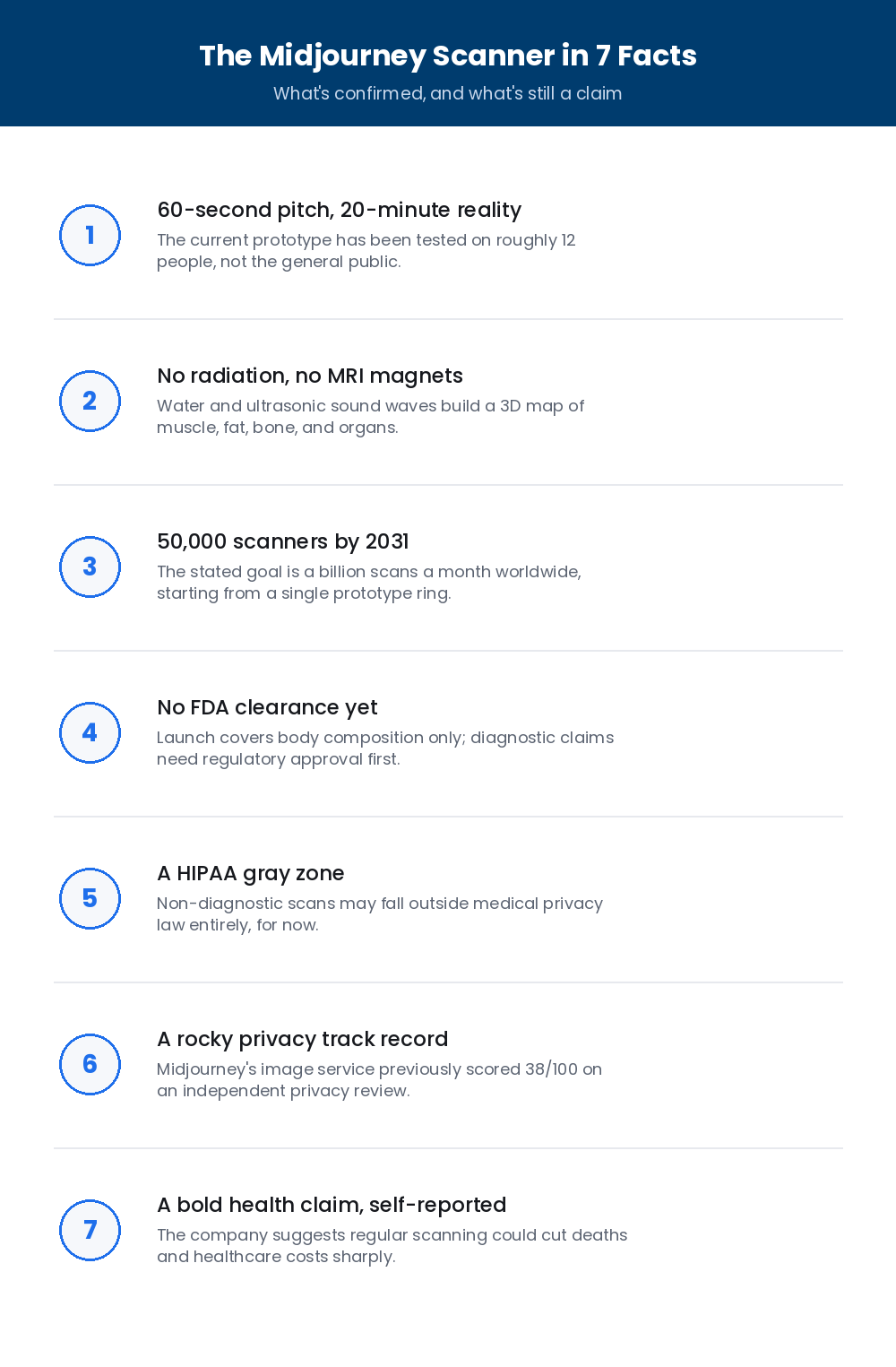 The Midjourney Scanner, separating the confirmed facts from the company’s own projections.
3.The Midjourney Spa business model
Instead of launching in a hospital, the first Midjourney Scanner units will live inside a spa. The company has signed a lease for a 25,000-square-foot space in San Francisco. It is expected to open by the end of 2027. Saunas, cold plunges, hot tubs, and a gym will sit alongside the scanners. The framing is deliberate: a scan becomes a casual byproduct of a nice place to spend an afternoon, not a clinical visit.
4.The billion-scans-a-month ambition
Midjourney’s long-term goal is genuinely enormous. By 2031, the company wants over 50,000 scanners deployed worldwide. Combined, they would have enough capacity to perform a billion scans every month. For context, that is roughly enough to give a meaningful share of the entire global population a scan on a regular basis. Getting there requires a still-unbuilt third-generation scanner with fully custom hardware.
5.Who actually owns your scan data?
This is the real question about the Midjourney Scanner, and it is not yet clearly answered. A full-body scan is among the most sensitive data a company could possibly collect. It reveals bone density, organ placement, body composition, and potential early signs of disease. The initial scans are body composition maps rather than diagnostic results. As a result, Midjourney has not classified itself as a HIPAA-covered entity. Normal medical privacy protections may not automatically apply.
That gap matters more given Midjourney’s history. An independent privacy review previously scored the company’s image-generation service at just 38 out of 100. Reviewers cited prompts and images that are public by default. A password can be changed after a breach. A body scan cannot be reissued the same way.
6.The health claim, and why it needs a caveat
Midjourney has publicly suggested that widespread, regular scanning could prevent 30% of deaths and cut healthcare costs by half. That is the company’s own projection, not an independently verified finding. Radiologists reviewing the announcement have also flagged a real risk called incidentalomas. These are incidental findings that look concerning but turn out to be harmless. At scale, they can trigger unnecessary anxiety and follow-up testing. For more on where this kind of ambitious AI infrastructure spending fits into the broader picture, see our guide to the AI spending surge.
What this means for you
None of this means you should avoid an eventual scan out of fear. Still, it does mean reading the consent form carefully before you get one. Ask directly where your scan data is stored, whether it trains any model, who can access it, and whether you can request full deletion. For the full launch details, see this PYMNTS coverage of the Midjourney Scanner launch and this critical analysis from The Register.
Frequently asked questions
Does the Midjourney Scanner actually take 60 seconds?
That is the stated goal, not the current reality. The prototype shown at launch reportedly took closer to 20 minutes per scan. It had been tested on roughly 12 people. The 60-second figure is an engineering target, not a confirmed result.
Is the Midjourney Scanner FDA approved?
No. Midjourney is launching with body composition maps, which do not require FDA clearance. The company plans to seek regulatory approval for diagnostic claims incrementally over time.
Who owns the data from a Midjourney body scan?
That is not yet clearly defined in public materials. The scanner is not currently classified as a diagnostic medical device. As a result, it may fall outside HIPAA protections that would normally govern sensitive health data in the United States.
Thinking about the privacy side of new AI products?
TekShove’s Web Development team can help you think through data handling and consent before you adopt any new AI-powered tool, hardware or software.
Talk to Our Team
Tell us what you need help with and our team will get back to you.