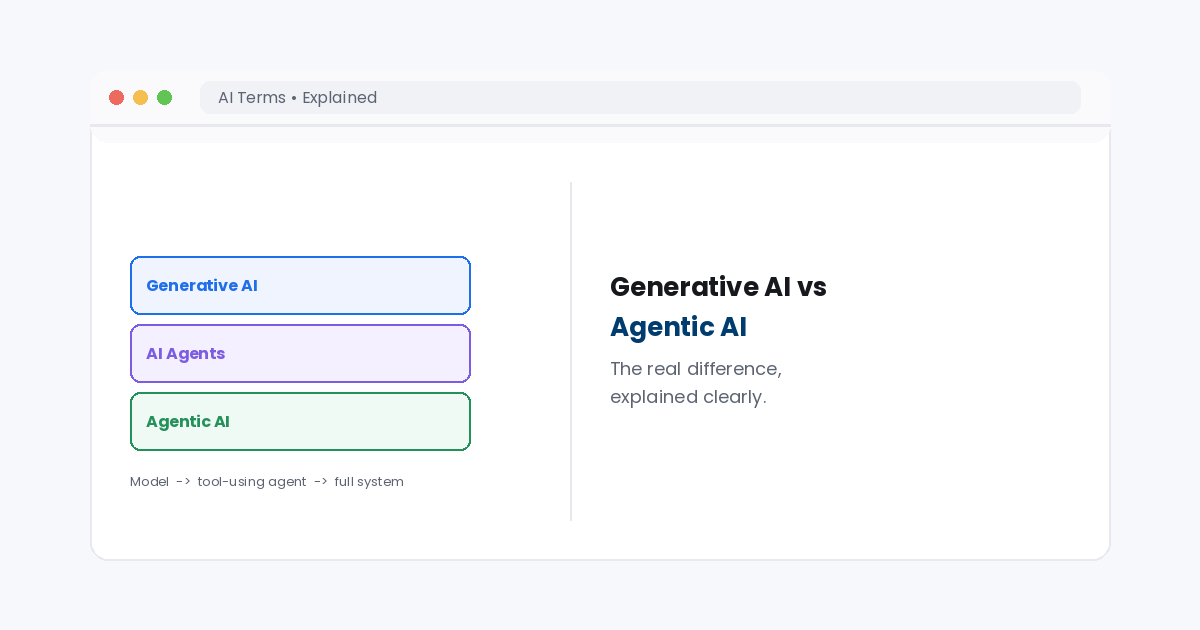
One model. One wrapper. One system. Generative ai, ai agents, and agentic ai are three different layers, not three names for the same thing.
These three terms get used as if they mean the same thing. However, they don’t. Generative ai creates content from a prompt. An ai agent wraps that model with planning and tools. Agentic ai is the full system running multiple agents together. Mixing them up is not just a vocabulary problem. It leads real businesses to buy the wrong tool for the job. This guide breaks each term down clearly, with the real data behind where adoption actually stands in 2026.
The short answerGenerative AI is the model that produces content from a prompt. An AI agent wraps that model with planning, memory, and tool access so it can complete a multi-step task. Agentic AI is the broader system, multiple agents and workflows operating together with minimal human oversight. Most businesses already use generative AI daily. Still, fewer have moved agentic AI into real production, mainly due to governance, not capability.
1.Why these terms keep getting confused
The confusion is not just academic. When a retail team asks for an AI agent and gets a polished chatbot built on a single model, that gap creates real friction. Similarly, when a healthcare system buys a generative AI platform expecting full automation, expectations were mismatched from day one. Notably, the platform still needs human input at every step. Getting the definitions right up front saves both budget and months of wasted planning.
2.Generative AI: the reactive content engine
Generative ai refers to models, most often large language models, trained to make new content: text, images, or code. It works reactively. You give it a prompt, and it writes a response back. It does not chase its own goals or act on other systems unless told to. Notably, ChatGPT’s 2022 launch brought this category into the mainstream. It still remains the most widely used form of AI in business today, even as other layers grow around it.
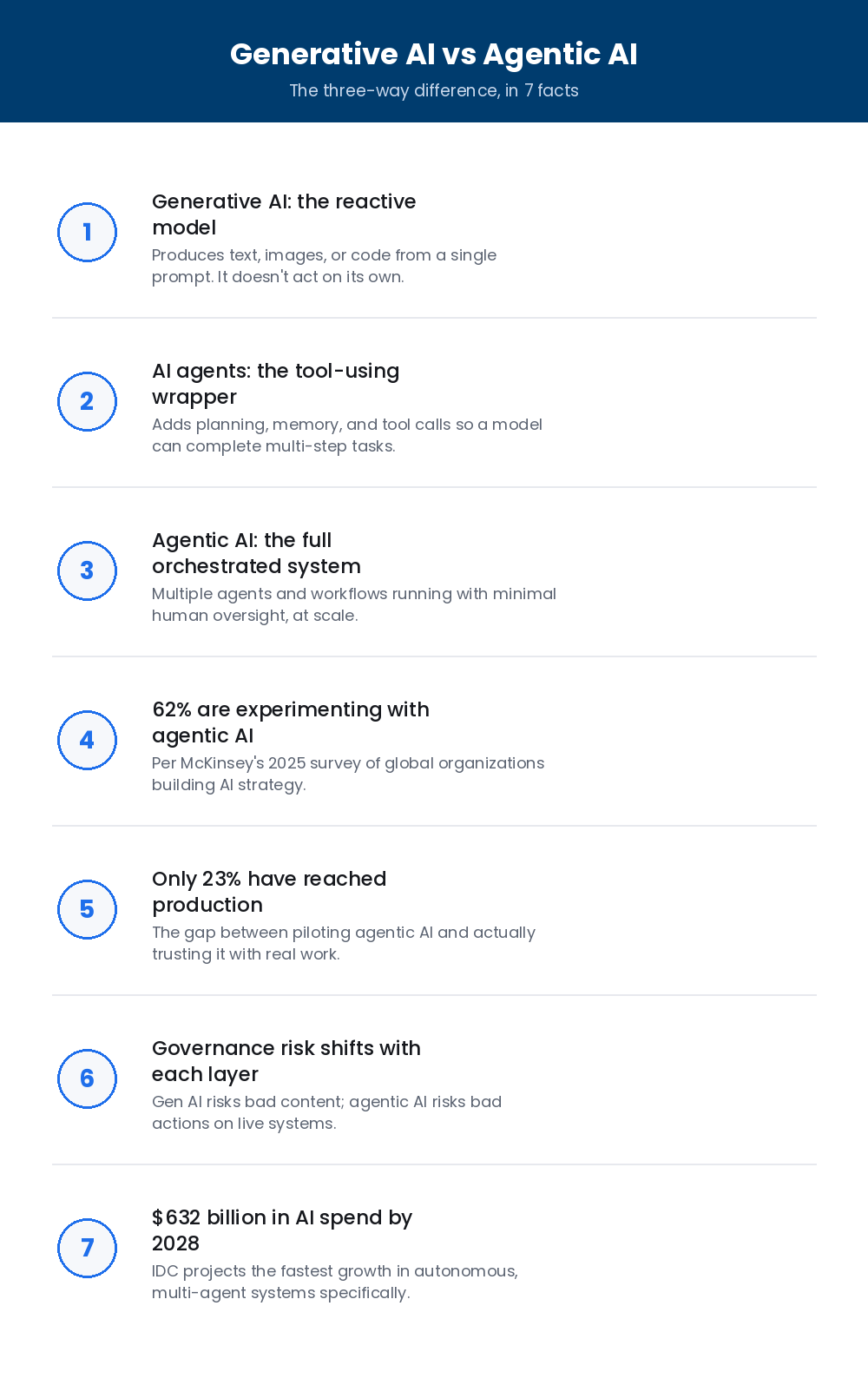 Generative AI vs agentic AI, the real difference in seven facts.
3.AI agents: generative AI plus tools and memory
An ai agent builds directly on top of generative AI. It adds planning, tool calling, and a working memory. This lets the model finish tasks across several steps instead of just answering one prompt. An agent can look up live info, call an API, or check its own work before finishing. In practice, nearly every real AI agent in 2026 still uses a generative AI model as its core. Essentially, the agent framework is what turns a single reply into a finished task.
Not sure which layer actually fits your business need?
We’ll walk through your real workflow. Then we’ll tell you honestly whether generative AI, an AI agent, or a full agentic system is the right fit.
4.Agentic AI: the full autonomous system
Agentic ai is the broadest of the three terms. It describes a full system of many agents, tools, and workflows. They all work together with little human oversight to reach a goal. Instead of one task, an agentic system might plan a whole project. It can hand pieces to specialized agents and change its own approach along the way. This is where real independence lives. Notably, it is also where real risk lives, since these systems act directly on live data and real business tasks.
5.The real numbers behind adoption
McKinsey’s State of AI Global Survey 2025 found that 62% of organizations are testing agentic AI systems. Only 23% have actually put them into real production. That gap is not really about tech readiness. Instead, it comes down to governance. Businesses need to know which system made a given call, what data it touched, and who stays accountable when it acts on its own. IDC projects worldwide AI spending will pass $632 billion by 2028. The fastest growth, notably, sits in autonomous and multi-agent systems.
6.How to actually choose
Start with your actual process, not the trendiest label. If your team still handles core work by hand, generative AI alone can build real fluency fast. It also proves value quickly. Meanwhile, if a task involves branching decisions or several connected systems, an AI agent fits better. Reserve full agentic AI for workflows genuinely complex enough to need multiple coordinated agents. Notably, make sure your governance model is ready before you hand over that much control.
How TekShove builds across all three
This is not just theory for us. Our Web Development team already uses generative AI for content and code. We also use AI agents for testing and routine tasks, and agentic workflows for larger multi-step builds. Still, real human review happens at every stage. Our SEO Marketing team applies the same layered approach to content and technical SEO work.
For more on the tools behind this shift, see our guides to AI coding tools, AI-powered web development, and loop engineering. This agentic AI vs generative AI comparison from Databricks and this explainer from Red Hat cover further reading.
Frequently asked questions
What is the simplest way to tell generative AI, AI agents, and agentic AI apart?
Generative AI is the model that creates content from a prompt. An AI agent wraps that model with planning, memory, and tools so it can complete a task. Agentic AI is the full system of multiple agents and workflows running together with minimal human oversight.
Do I need agentic AI, or is generative AI enough for my business?
It depends on the task. If you need help producing content, generative AI alone is often enough. When a task requires several steps, external tools, and ongoing decisions, an AI agent or a full agentic AI system fits better.
Why do so many companies struggle to move agentic AI into production?
Governance is the main gap. Businesses need to know which system made a decision, what data it touched, and who is accountable when it acts autonomously. Many organizations pilot agentic AI successfully but stall before giving it real operational control.
Ready to use the right AI layer for your actual need?
TekShove builds with generative AI, AI agents, and agentic workflows, matched honestly to what your project actually requires.
Talk to Our Team
Tell us what you need help with and our team will get back to you.