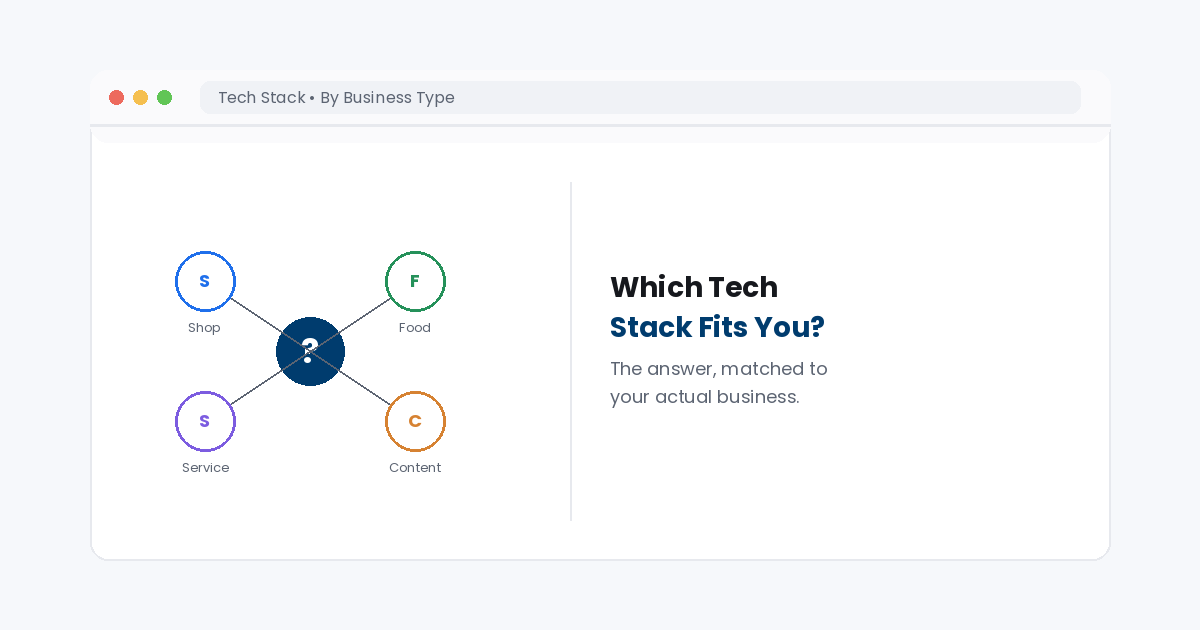
One question, four common answers. The right tech stack depends on what your business actually does.
Every business owner eventually hits the same wall: which technology should I actually use? Developers throw out framework names. Friends recommend whatever they used last. Nobody asks the one question that actually matters: what does your business do? The right tech stack for a restaurant looks nothing like the right tech stack for a consulting firm. This guide walks through the real answer for the most common business niches, so you can stop guessing.
The short answerThere is no single right tech stack. There is only the right tech stack for your specific business. Online stores usually start with Shopify or WooCommerce. Meanwhile, restaurants need cross-platform mobile apps backed by reliable cloud infrastructure. Service businesses need a booking-first setup. Content and lead-generation sites do best on WordPress with strong SEO. Overall, match the tool to the actual job, not the other way around.
1.Why “just pick something popular” fails
Most business owners ask the wrong question first. They ask what’s trending, or what a friend’s developer used. Popularity is not the same as fit. A framework that works brilliantly for a fast-moving startup can be the wrong choice for a service business. That kind of business just needs reliable online bookings. Overall, picking tech this way often means paying twice: once for the wrong build, and again to redo it later.
2.The real question to ask first
Start with your business, not the technology. What problem does your website or app actually need to solve? A store needs to process orders and payments reliably. Meanwhile, a restaurant needs speed during a lunch rush, and a service business needs to fill a calendar. Once you know the real job, the right tech stack becomes much easier to see. Budget, team skill, and growth plans matter too, but they come after this first question, not before it.
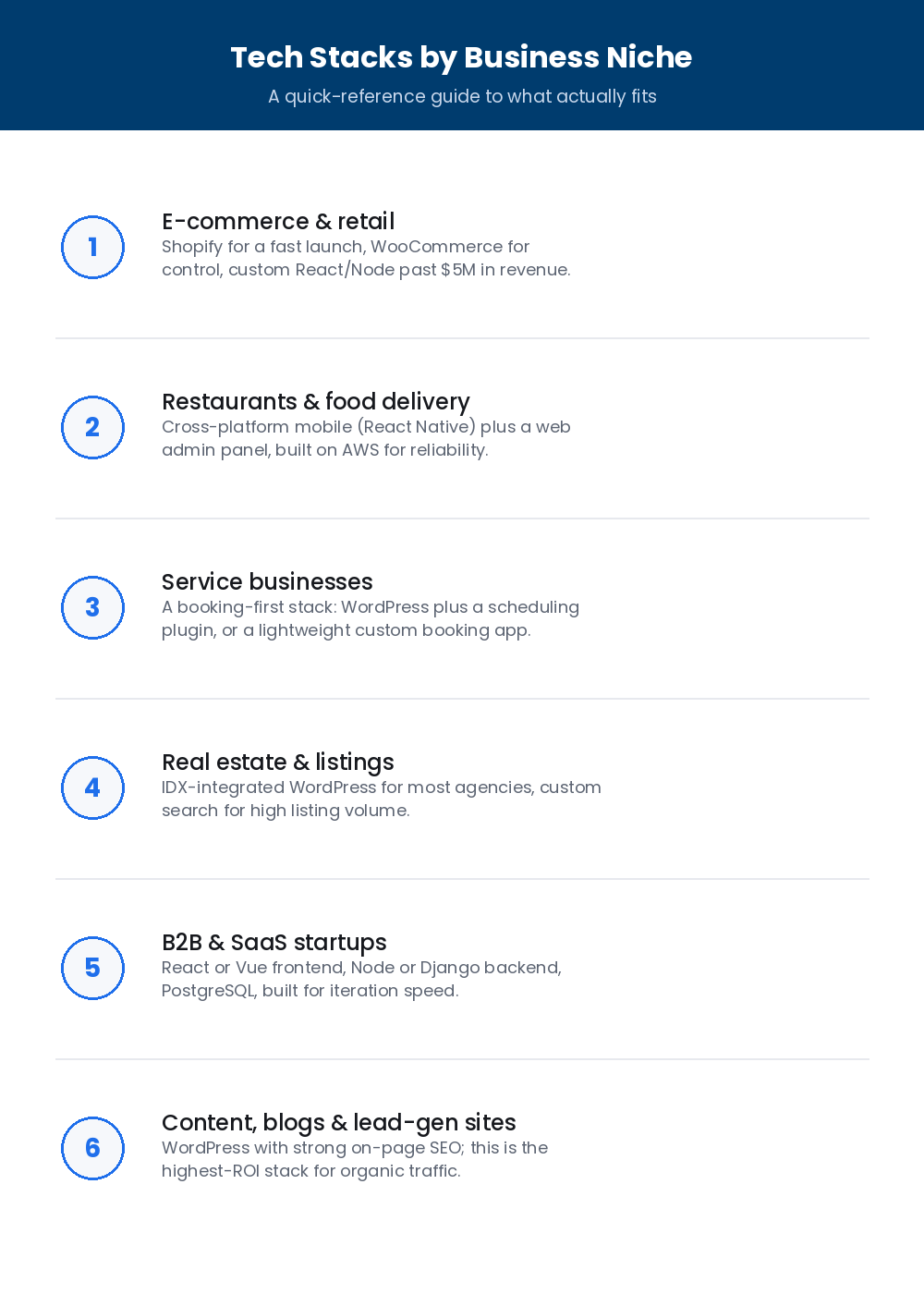 The right tech stack, matched to six common business niches.
3.E-commerce and retail
For most online stores, Shopify remains the fastest, lowest-risk starting point. It handles hosting, payments, and security out of the box. Instead, WooCommerce is the better fit if you already run WordPress and want more control over customization. Once a store passes roughly $5 million in annual revenue, a custom build often makes sense instead. React on the frontend and Node on the backend give full control over checkout and integrations at that scale. Start simple, and graduate to custom only when you genuinely outgrow the simpler option.
4.Restaurants and food delivery
Restaurant apps get tested hardest during the lunch rush, when orders pile up fast. A cross-platform mobile app, built with React Native, covers both iOS and Android customers with one codebase. Pair that with a web-based admin panel for staff. In practice, back-office work is usually easier to manage on the web than inside a mobile app. Cloud infrastructure matters more here than in most niches. Payment webhooks and order events need to survive sudden traffic spikes without failing.
Still not sure which stack actually fits your business?
Tell us what your business does. Instead of pushing the most expensive build, we’ll walk you through the real options honestly.
5.Service businesses
Clinics, salons, consultants, and similar businesses share one core need: a full calendar. The right tech stack here is booking-first, not feature-first. Notably, a WordPress site paired with a scheduling plugin covers most service businesses well, at low cost and fast setup. Still, larger operations with complex scheduling rules, multiple staff calendars, or custom workflows may need a lightweight custom booking app instead. Either way, the booking flow deserves more attention than the homepage design.
6.Content sites and lead generation
If your business runs on organic traffic, blog content, or lead capture, one stack still wins in 2026: WordPress paired with strong on-page SEO. It is flexible, well-supported, and built around the exact things search engines reward. Notably, fancy custom frameworks rarely move the needle here. What matters is content quality, site speed, and technical SEO fundamentals done properly, which is easy to underinvest in and expensive to fix later.
What this means for your business
You do not need to become a developer to make this decision well. Instead, you need to know what your business actually does, day to day. Match the tech stack to that reality. If you are not sure where your business fits, that uncertainty is normal, not a failure on your part.
Choosing between web, cross-platform, and native builds is one closely related decision. Our guide to cross-platform app development covers that in more depth. This e-commerce tech stack guide from Smart WebTech and this restaurant app stack guide from DEV Community cover the deeper technical detail behind these niche breakdowns.
Frequently asked questions
How do I know which tech stack is right for my business?
Start with your business type, not a trending framework. An online store, a restaurant, a service business, and a content site all need genuinely different tools, since they solve different core problems.
Should I choose Shopify or a custom build for an online store?
Shopify usually wins for a fast, low-risk launch. A custom build makes more sense once a store passes roughly $5 million in annual revenue. At that scale, React and Node give you deeper control over checkout and integrations.
Is WordPress still a good choice for a business website in 2026?
Yes, particularly for content sites, service businesses, and lead-generation pages where strong SEO matters most. WordPress paired with solid on-page SEO remains one of the highest-ROI stacks for organic traffic.
What if my business doesn’t fit neatly into one niche?
Most real businesses are a mix. Pick the closest matching niche as a starting point. Then adjust for your specific mix of e-commerce, service, and content needs, rather than forcing a single template to fit.
Ready to stop guessing and pick the right tech stack?
TekShove can walk through your specific business and recommend a tech stack that actually fits, not just the one that’s trending.
Talk to Our Team
Tell us what you need help with and our team will get back to you.