One flat tier retired. One meter running instead. X api pricing changed for good in 2026.
If you built anything on X in the past, the rules just changed again. X api pricing moved away from flat monthly tiers toward a pay-per-use model in 2026. Notably, the shift affects anyone posting, reading, or automating on the platform. This guide covers exactly what changed, what it costs today, and what to do if the new pricing makes your project too expensive to run as-is.
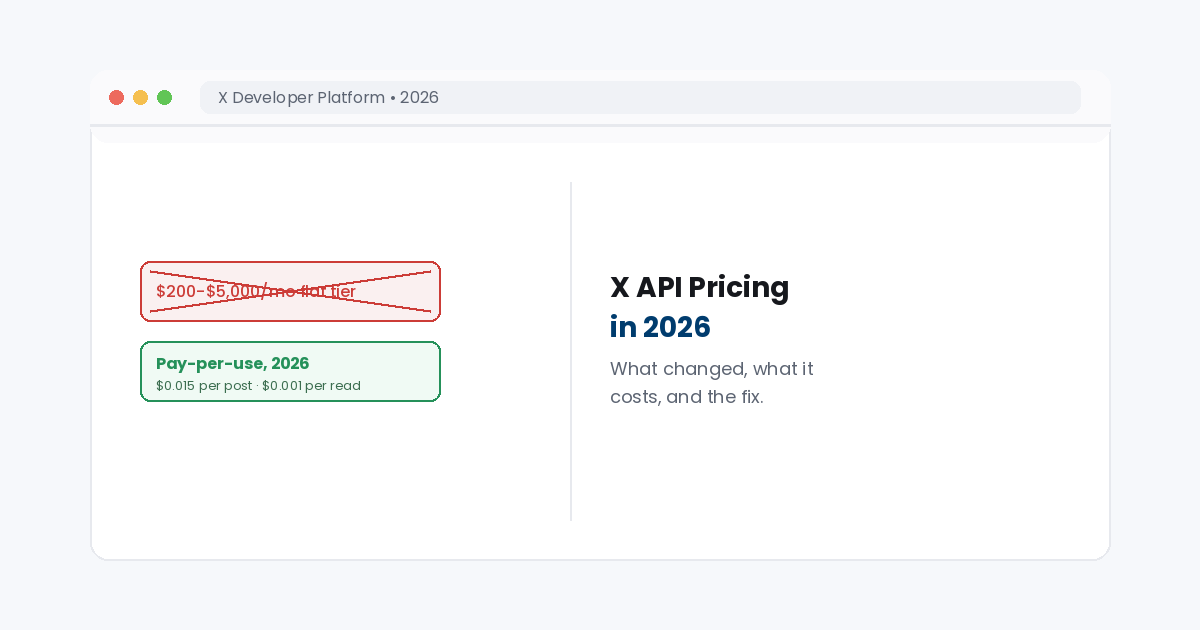
The short answerX api pricing shifted from flat monthly tiers to pay-per-use as the default in 2026. The old 200 dollar Basic plan is retired, and the 5,000 dollar Pro plan is closed to new signups. Posting now costs 0.015 dollars per post, or 0.20 dollars if the post includes a URL. Meanwhile, reading your own data through Owned Reads endpoints costs 0.001 dollars per resource, capped at 2 million reads a month. Notably, some actions, like following and liking through the API, are gone from every self-serve tier entirely.
1.What changed in x api pricing during 2026
X api pricing used to work like a phone plan. You picked a tier, paid a flat monthly fee, and got a fixed bucket of calls. That model is gone for new developers. Pay-per-use is now the default starting point. It starts with a 0 dollar base fee, then adds charges per call as you use the platform. Instead of guessing your usage months ahead, you pay only for what you actually consume. Essentially, that sounds simple, until you see the real per-call math at any real volume.
2.The real x api pricing costs today
Here is what the numbers actually look like. A standard post costs 0.015 dollars through the API. In contrast, a post with a URL jumps to 0.20 dollars. That matters a lot for marketing or business accounts that link out constantly. Meanwhile, reading your own data, through endpoints like bookmarks, followers, and mentions, runs 0.001 dollars per resource under the new Owned Reads pricing. The pay-per-use tier caps reads at 2 million a month. Notably, following, liking, and quote-posting through the API have been removed from every self-serve tier completely.
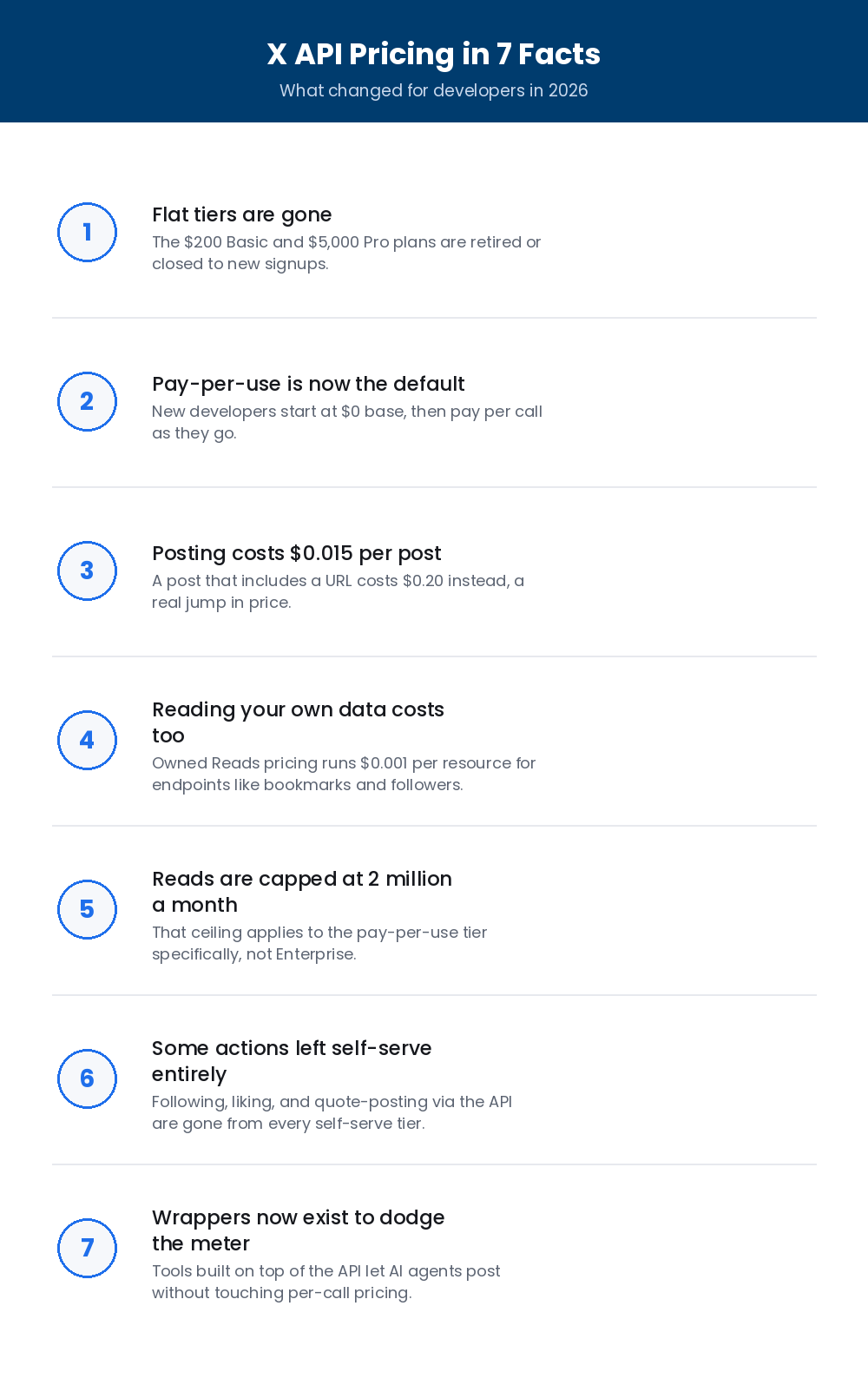 X api pricing in 2026, the real numbers behind the shift.
3.What happened to Basic and Pro under the new x api pricing
The old Basic tier, priced at 200 dollars a month, is fully retired. Existing Basic subscribers were force-migrated to pay-per-use pricing after June 1, 2026. The Pro tier, at 5,000 dollars a month, still works for accounts that subscribed before the cutover. Still, it stays closed to new signups entirely. Enterprise access remains available, though only through a direct sales conversation rather than a self-serve signup.
Building a project that needs X integration?
We’ll walk through your actual usage first. Then we’ll show you honestly whether the official API, a wrapper tool, or a different approach fits your budget best.
4.Why X made this change
X has been trying to win back developers who left after earlier price hikes shut down many third-party apps. Ironically, those earlier restrictions hurt overall platform usage. Tools that once connected people to X simply stopped working. Notably, the pay-per-use shift is framed as more developer-friendly. Whether it actually is depends heavily on your specific usage pattern. Low-volume projects tend to benefit. In contrast, high-volume, link-heavy accounts can end up paying more than they did under the old flat tiers.
5.The wrapper alternative
Not every project needs to touch the official X API directly. Instead, wrapper tools now sit on top of it, handling the API relationship on your behalf while charging their own, often simpler, pricing. Some of these tools include an MCP server, letting AI agents and automation tools post to X without touching per-call pricing at all. Overall, this route can be genuinely simpler than managing API credits directly for straightforward publishing and scheduling needs.
6.What to do if this breaks your budget
Start by estimating your real monthly volume honestly, not your best-case guess. If you mostly need to publish and schedule posts, a wrapper tool likely covers the need at lower complexity and cost. Deep read access, live streaming data, or advanced analytics, in contrast, still calls for the official API. Plan the per-call math into your budget from day one instead. That beats discovering it after launch.
How TekShove handles X integrations
API pricing decisions like this affect real client projects, not just hypothetical ones. Our Web Development team evaluates the real cost of any social integration, X included, before it ever becomes part of a client build. Sometimes that means the official API. Other times, in contrast, a lighter wrapper tool serves the same goal for less.
For more on how we build with modern development tools generally, see our guides to AI-powered web development and AI coding tools. This detailed X API pricing breakdown from Blotato and this coverage from Social Media Today cover further reading.
Frequently asked questions
Is there still a free tier for the X API in 2026?
No. X retired the legacy Basic plan, which used to cost 200 dollars a month. The Pro tier is closed to new signups. Every new developer now defaults to pay-per-use pricing, with no meaningful free option left.
How much does it actually cost to post on X through the API now?
A standard post costs 0.015 dollars through the API. Adding a URL raises that to 0.20 dollars instead. That is a real jump for anything link-heavy, like most marketing or business posts.
Do I need to use the official X API to post automatically to X?
Not necessarily. Wrapper tools now sit on top of the X API. They let AI agents and automation tools post without triggering per-call charges directly. That can be a simpler option for straightforward publishing needs.
Planning a project that touches X or other social APIs?
TekShove can help you scope the real cost before you build, so pricing changes like this one don’t blindside your budget later.
Talk to Our Team
Tell us what you need help with and our team will get back to you.